Art, blog, History, Kansas City, music, Story, Uncategorized

My House The Trading Post A Gift

horse-varnish

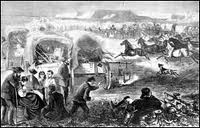
A Mexican man, who could not speak English, was a familiar figure in Westport, because he traveled back and forth over the Santa Fe Trail. On his stay in Westport, he fell in love with a woman named Mamie, who couldn’t speak Spanish. With the help of Mr. Polk, an interpreter, the Senor, offered Miss Mamie a gift of a beautiful lady’s riding horse with white satin bridle and a magnificent silver studded Mexican saddle. Along with the saddle, twenty-six loaded wagons with every yoke of the oxen decorated with a white satin rosette. This gift was offered if she would accompany him to Mexico. Mamie was only 16 years old. She turned him down. Mexico was a long way from Westport, Missouri, and her friends. She did not want to be in a strange country, unable to converse with her husband.

This daughter of a pioneer, cried so bitterly, and was so unhappy. Because she loved the foreigner. The Senor knew this, so he arranged for her childhood friend, Stevie, (future Senator of Missouri) to go to Mexico with them. Together, Stevie and the Senor helped Mamie learn Spanish. Stevie Polk was promised a position of wealth.  During his time there he was able to defend a client in Spanish before a Mexican judge. Mamie, however, grew lonely and wanted a companion of her own race and language and wanted to leave the strange country.

The Senor and Mamie had three sons. The boys were sent back to Westport to be educated. This gave Mamie the opportunity to make many travels to Westport over her lifetime. Mamie returned to Westport, years later, and worked as a cook for McCoy’s Tavern. McCoy’s Bar and Grill is still located at the corner of Westport road and Pennsylvania.

The people of Westport haven’t changed, we’re very much alike, and what was true of one neighbor, neighborhood, or family was true of all. The people of Westport, in 1853, would travel three to five miles to visit another family. One entire family would make arrangements to stay for several days or a week. They contented themselves with visiting each other. In the Twenty-First Century, Westport families, still come together during the holidays, like 4th of July, my birthday, and Christmas. And giving pretty gifts is still a tradition.

Mamie was offered a wonderful gift from the man who loved her. Her acceptance took her on an adventure she didn’t really know she wanted to be a part of. I can relate.
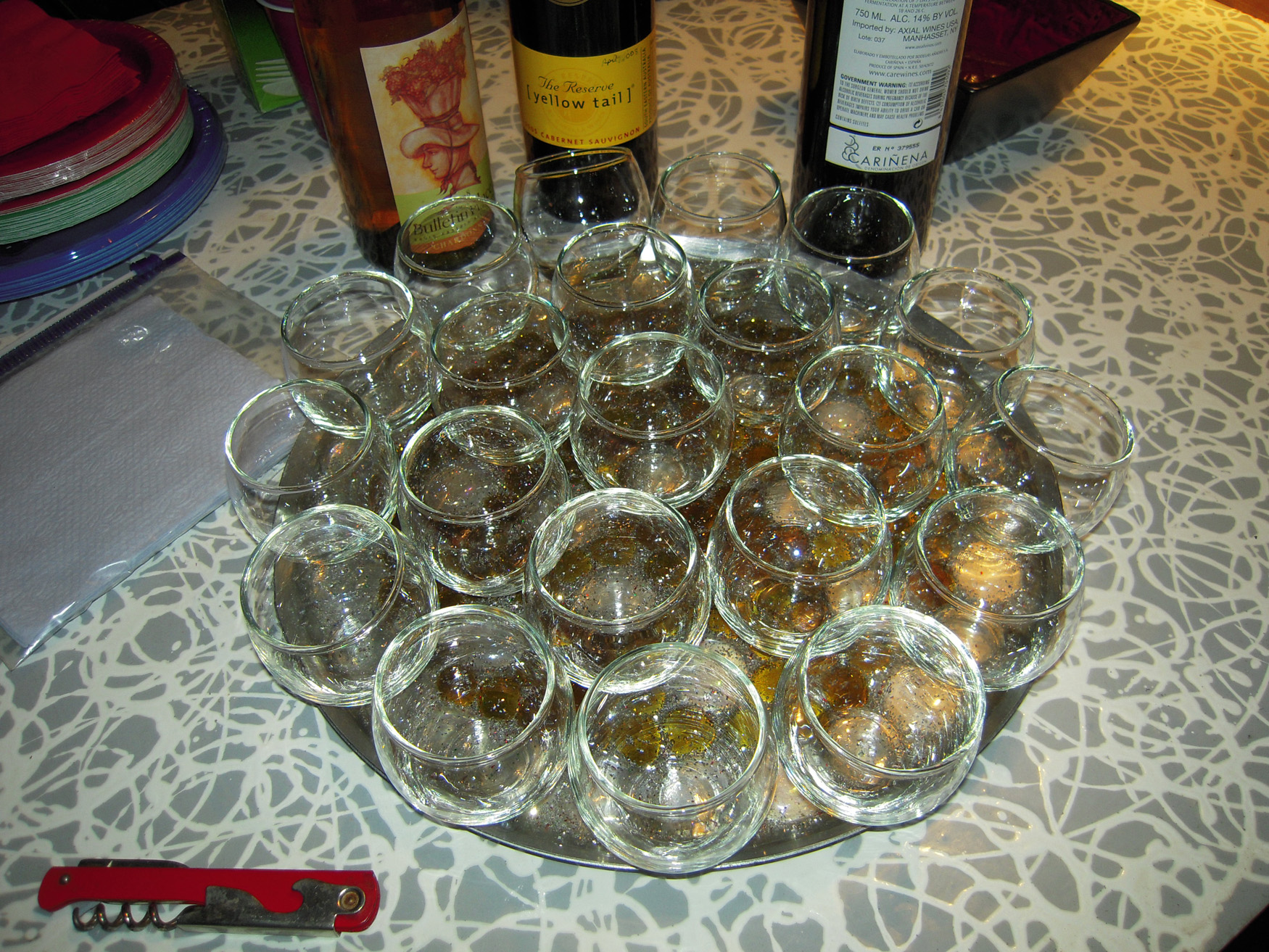
wine glasses

I met my husband Bob, a long time ago, when I was 11. He was a grown man, in his late twenty’s, driving an expensive sports car, an Austin Martin with Missouri plates. He laughs when I tell the story. He barely remembered the insignificant little girl he almost ran over, until the day, I came to his law office, thirty-two years after our first encounter.  “I’ve Always Loved You.”

I sat in his law office, flipping through his photography portfolio; he had on the side table. He typed my divorce information into his computer. He was a very good photographer. One photo, the very first picture I opened the page on, was of the little blue sports car. Which brought back the memories of when he nearly ran over me, back in 1974. An incident, where a well-dressed business man nearly took my life. He grabbed my arm and said, “Little girl, you shouldn’t run out into the street!”
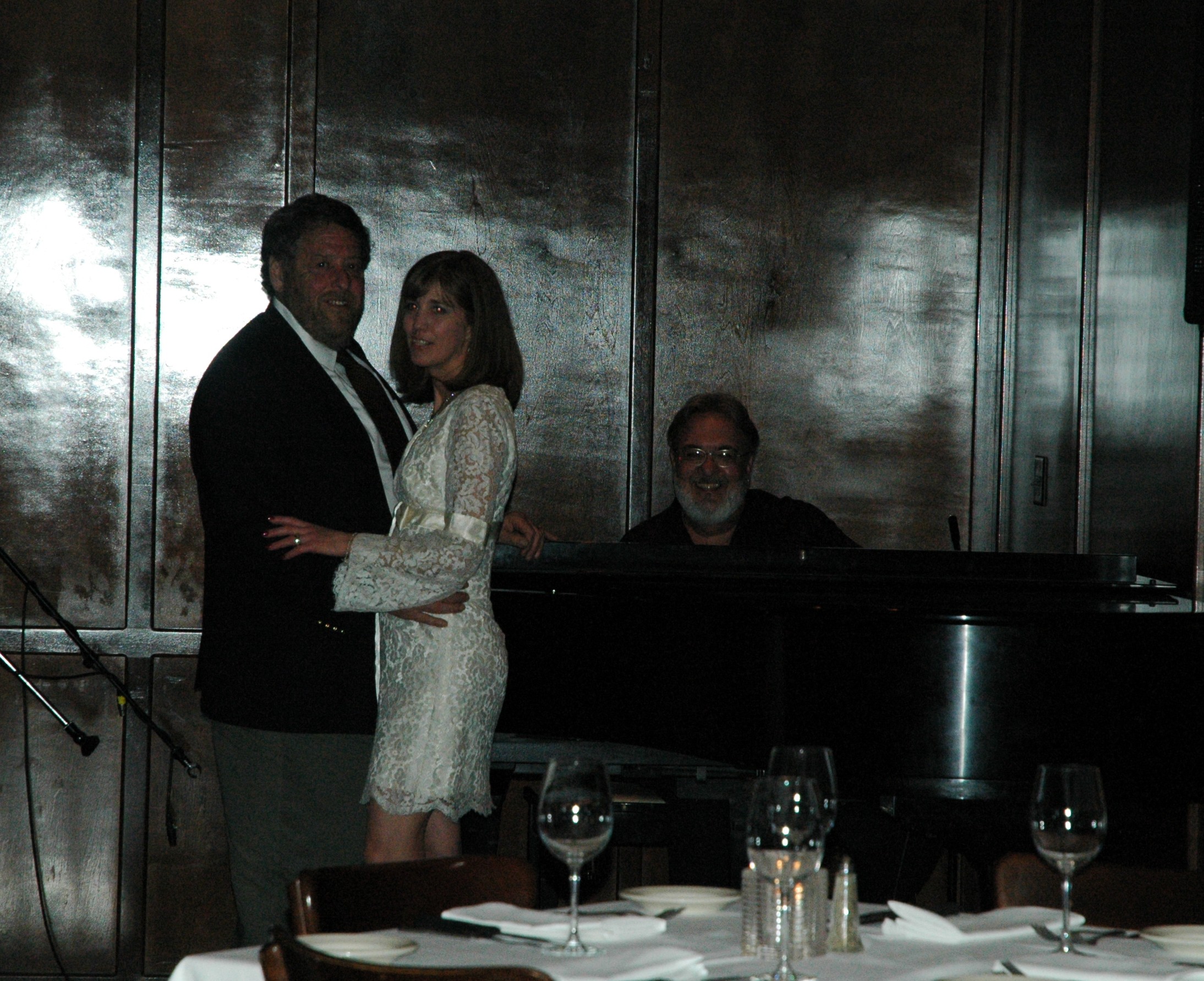
DSC_0069

The morning came slowly. Outside, all was wet from the early morning rainstorm. I always sleep better during the rain. Not wanting to get out of bed, I reached for my husband, and he kissed my hand. We snuggled closer and I fell back to sleep.

Bob had gotten up several times in the night, he’d been a little restless lately, and suffering from a sore back. A few days back, he went outside to clean up the garden and somehow managed to slip and fall on the old wet decking. He didn’t feel injured at the time, now he’s in pain. He is not interested in seeing a doctor, which is the only advice I can offer.

Bob continued to lie in the bed for the rest of the morning. With a muscle relaxer and pain pill. I can only hope that he gets better soon. I know it must have been a nasty fall. It left a yellow and gray bruise along the side of his back. I realized it was another episode of nothing really works out very smoothly.

My house once served as a trading post on the Santa Fe Trail and popular spot for old gamblers. Like Doc Holiday, a true gambler that was known to play in this particular saloon. Some of the best poker games were won here. Bob took a gamble on love; we both did, when we got married. He had been a bachelor, with an impressive history himself. He had traveled, played music professionally, his artwork was displayed everywhere in the house, and his Ivy League law degree made him one of the most interesting men I had ever met.

Anniversary-Portrait

I’ve Always Loved You

by Robert A. Simons

So much emotion.
Such a long, long time,
So many nights alone,
Till your eyes met mine.
And now when dark days come,
Your love keeps them away.
Now that your love, 
Is here to stay.
So much emotion.
Such a long, long time.

So much confusion.
Lifetime for a dime.
I waited here for you,
Till my twilight time.
I wish we cold both be young,
And never let love slip away,
Now that your love
Is here to stay.
So much emotion,
Such a long, long time.

I've always loved you.

I've always loved you.
Always loved you,
And I do.
So much emotion.

Such a long, long time.

Enjoy this song on SOUNDCLOUD: https://soundcloud.com/blue-tattoo/ive-always-loved-you-broadcast

					
Standard
Art, blog, History, Kansas City, music, Story, Uncategorized

The Belles of Westport My House The Trading Post

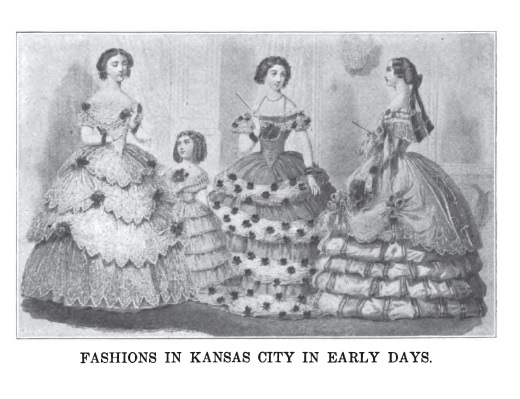
Fashions in Kansas City

The room lite with candles “shone brightly upon the fair maidens with glossy water-falls, delaine or tissue dresses, hoop skirts and family jewels.” Young men and women, alternated standing in a circle. They moved left, holding a partner’s hand, in a game called, “Marching down to old Quebec.” In 1850, dancing in Kansas City, was forbidden by the churches. The young folks were allowed to have large parties, accompanied by some older persons, but the kids refused to call them “chaperons.” For fun, packs of older teens, would take a passage on one of the Missouri River Boats, and dance on deck to the fiddler music. A jolly captain, with a crew that supplied the teens with good southern cooking, made this excursion highly enjoyable.

Dancing became fashionable among the married sect of society women and their husbands, (the business men of Independence, Westport, and Kansas City). The two favorite events were the Pallas Ball and the Charity Ball. These events were given by the young ladies, who were teachers at the local schools and day nursery.

kitchen convo4 girls kitchen

My house the trading post, in Westport, was refered to as a dance hall. It catered to the other type of family. The families of sturdy, good people, whose life was that of the frontier. From which they endured many hardships moving westward. The rules and manners of the parties attended, were at the discretion of the host. A party at the old Westport saloon would involve dancing and a “kissing” game. This would be followed by a “supper” that included pumpkin pie, peach pie, and buttermilk. Afterwards, the fun would continue with a run through the backwoods with candles.

The most desired and eligible young men were from Westport. The prettiest and wealthiest girls were from Kansas City or Independence. The finest parties were hosted by the sons and daughters of the first trading posts and saloon owners. The Santa Fe trade made these families wealthy. They built fine mansions within Jackson County. Their parties were legendary and drew in all the prettiest girls.

McCoy’s notes document that the Johnson Homestead, was near the long canon river bluffs, and had been occupied by Judge Bales who turned it over to Doctor Smart. John Johnson, had six children and a wife. The Johnson’s family were Methodist. They held family events south of Westport on the Indian Mission. The purpose was to honor the Indians. It should be noted that the Johnson family was adopted by the Shawnee Mission Indian’s Chief, in 1850, because of their great kindness to the tribe. The Johnson family and Shawnee Indian’s relationship is well documented. My daughter Megan has married into a Johnson family and given us, Eddie Johnson.

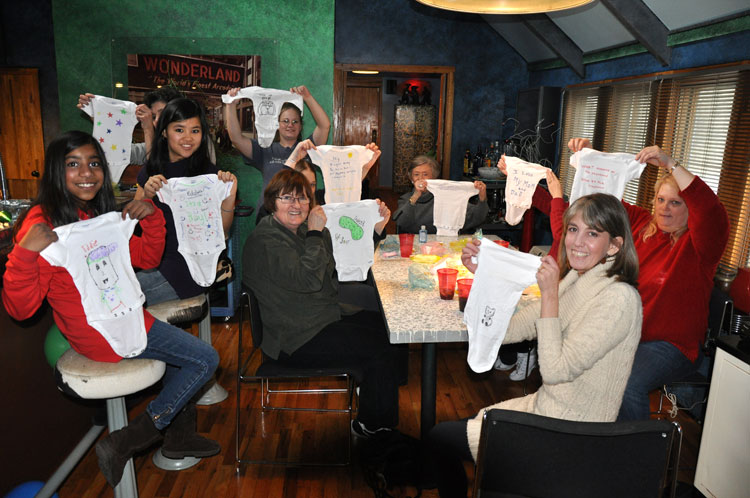
_T-shirts

Before bridge parties and book clubs were popular, quilting parties were the social occasion for the mothers and daughters.  Some girls would travel ten miles to arrive as early a nine o’clock in the morning, to quilt. The ladies arrived by carriage (with an old black man as a driver), pulled by one of the girl’s own personal riding horses. In the company of the other quilters, pioneer women, brought up with cortly manners and elegances, kept their words polite.  The women sat on rush bottom chairs around a quilting frame while stitching in different areas.

In the olden days they said that Independence was a town with good breeding, and that Westport was a town of “good fellowship,” and that Kansas City had both, good breeding and fellowship. The belles of Independence went to some of the best schools of the west. The Wyandotte Indian girls traveled to Independence to attend the fine colleges for young women. One historic book described the daughter of a Westport man, who complained her father made fun of her eloquent educated speech; that she often spoke one way, while at home, and another when away at school.

Westport was a natural trading post for the people everywhere, going everywhere, each one carrying with them a story. Men were charming and the women strived for refinement. Many of the girls that made the society pages were called eligible belles. The daughters of the founding families, of the three cities, were described as popular and beautiful. Stories of romances and first tragedies fill the pages of history books. Kansas City, being proud of their citizens, kept many scandals out of the records.

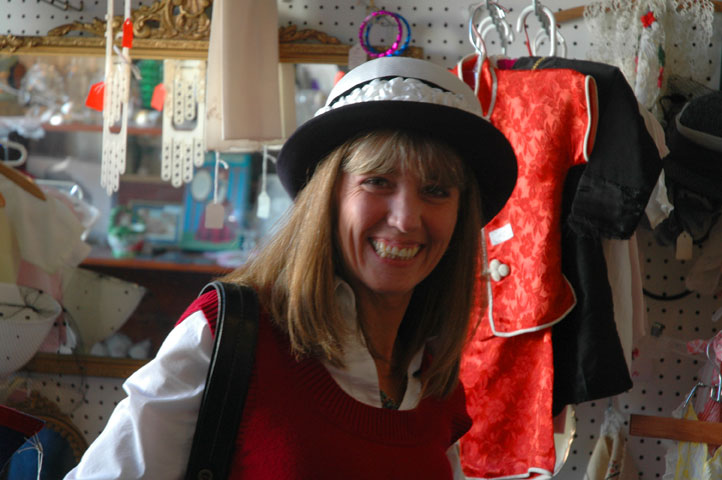
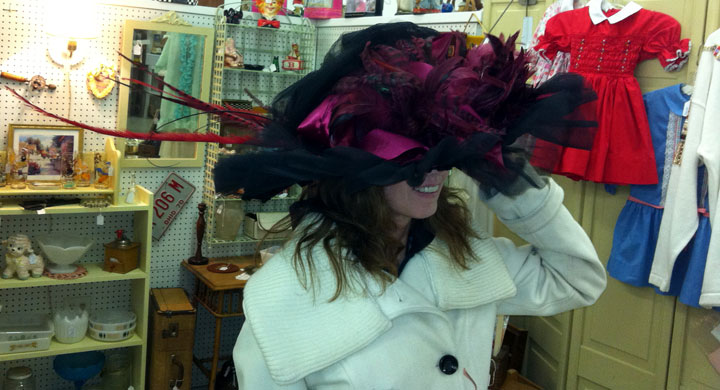
white-hatHATIMG_0003

In the summer of 1850, the local trading posts and general stores received shipments of French and English, joconets, French challies, lace manellas, parasols, fans, kid and filet gloves, cotton and silk hosiery. Special signs called attention to Ladies’ Bonnets and the Millinery department for the latest Paris styles. Most orders from France arrived within thirty days. The fourth of July, brought out all the daughters to town for new purchases.  Everyone was getting ready to attend the celebrations of band music or the various balls hosted by the local hotels and taverns.

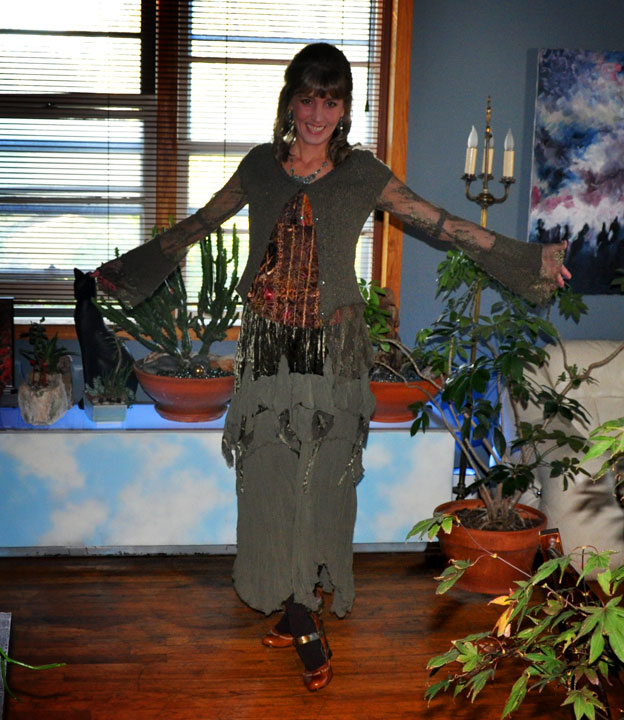
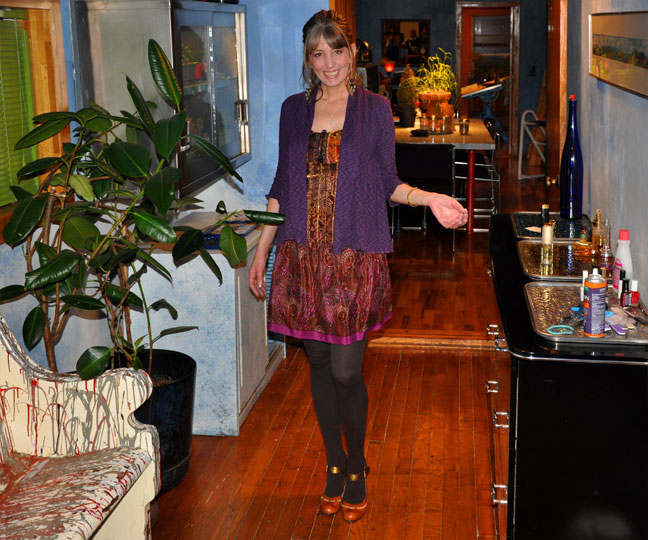
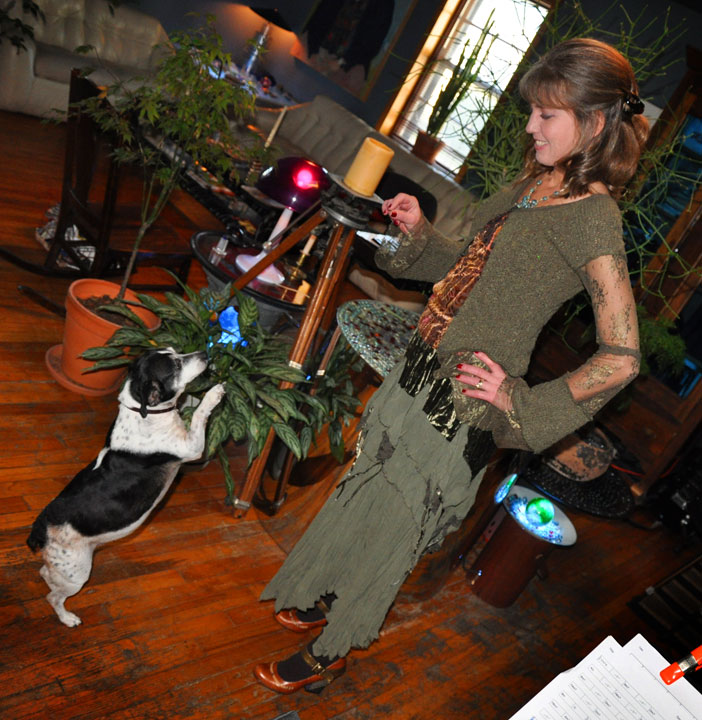
_dressFridge_Terrie-Outfit_dress-and-dog

Today, the most common women’s fashion in Westport or Kansas City, Missouri is the skinny jean and the knee-high boots, ankle boot, or cowboy boot.  This is a good look on most ladies, especially if paired with an extra long top or mini-dress. Television shows like, any of the “housewives reality shows” provide a gist of which fashions are popular. However, in little Ol’Westport, we have specialty dress stores, where one of a kind outfits can be found. Everyone else shops at Walmart (or Target). What they end up with, is every other girl, wearing the same thing.

Even as far back as 1909, Mrs. Westlake, a high society lady of Kansas City, noted that the women’s wear was not very stylish. Mrs. Carrie Westlake Whitney was appointed the librarian in March, 1881. In her account of her first visit to Westport, she writes,”there was incessant hammering and banging from a dozen blacksmith’s sheds, where the heavy wagons were being repaired, and the horses and oxen shod. The streets were thronged with men, horses, and mules. While I was in town, a train of emigrant wagons from Illinois passed through to join the camp on the prairie. A multitude of healthy children’s faces were peeping out from under the covers of the wagons. Here and there a buxom damsel was seated on horseback, holding over her sunburnt face an umbrella or a parasol, once gaudy enough, but now miserably faded.”

Boots-3rd-A

Kansas City women have been forming new clubs since the pioneer times. The women gathered to provide stimulus of association, the desire to engage in analytical thought and sustained discussions. They realized that as an organization they could broaden and deepen their intellectual work and accomplish more. In that same spirit I have established an organization, called the Professional Business Women’s Club of Kansas City, http://pbwckc.webs.com

The first ladies, who started organizations and clubs in the pioneer day sent letters out to the women they knew and messages delivered by their driver. I am sending out an invitation by blog; to any individual, female or male, that enjoys the History of Kansas City, the town of Westport, or believes children can become brave, creative, leaders from playing group sports, like soccer, to join my club, PBWCKC. http://pbwckc.webs.com/apps/members/

Wishing you many warm moments to share this Christmas. Thank you.

Standard
Art, blog, History, Kansas City, music, Story, Uncategorized

My House The Trading Post Pioneer Days

Chapter 1

Early Settlers In Pioneer Days

1900's
1900’s

Kansas City was one of the stopping places for early settlers in pioneer days. At one time people traveled through Kansas City by boat, horseback, and stage-coach. Missouri offered all a man could desire, rivers, valleys, hills, and plains. Yet, people were on the move West. The reasons for travel varied from fur trapping, hunting, adventurers or quest for gold.

A small group of men organized to form the town of Westport in the 1820’s. These early settlers liked the wilderness area west of Independence Missouri and North of Saint Louis. Lewis and Clark, years earlier, had noted the territory was perfect for resting the horses with its sheltering woodlands and clear running springs.

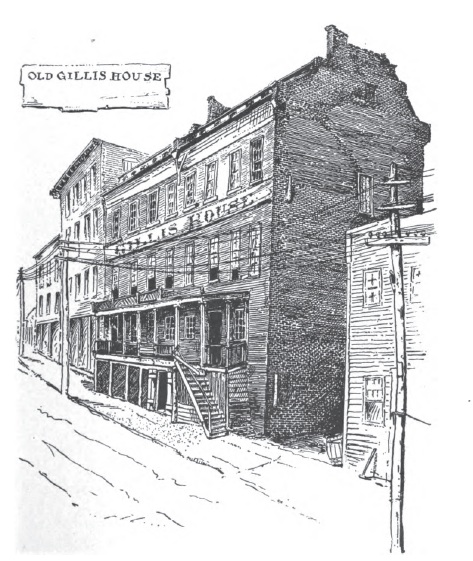
Gillis house

The first structures were log cabins. Boards were applied to the esteriors later. The general shape of these oldest buildings like my house, had small panes of glass, and an outside chimney. One of the popular establishments that developed in those early days was that of the Trading Post. Trading practices with the Indians flourished because traders had a great influence with the Indians and the government relied on this relationship. The Indians were extended credit and the traders were soon able to replace the log cabins with two-story Taverns and Dance Halls.

Westport became a rough and rowdy frontier town. The town was overrun with gun-toting renegades, drunken Indians, and Mexican War soldiers. A man named, Vogel, ran a tavern in Westport.  Taverns in those days were used for community business, socializing, weddings, and funerals, which took place in the large main room, often fitted with a bar and some shelves. My house is that tavern.

In the winter of 1829, a resident of Westport, a Mrs. Rachel Patterson was widowed when her husband had a heart attack. Mrs. Patterson survived with 6 children, I think mostly boys. Sadly, Mrs. Patterson was denied the right to have title to her land where Mr. Patterson had built their homestead. Her land was situated on the far west quadrant of Westport, along the Kansas State Line. Kansas at the time was Indian Territory.

Most mothers snatched their children from the paths of the madmen and travelers in Westport. However, the Patterson children played with the Indian children from the Kansas reservation and grew up friends with the Indians and had a way with making friends with folks around town. This was a lucky thing for Widow Patterson, because, as she took her “land ownership” case to court, she would need a few secret admirers to help her succeed.

Mrs. Patterson vs. the State of Missouri, Jackson County, Westport Kansas City, was a case that is documented to have started in 1830 and wasn’t settled until 1877. Widow Patterson did win her case. But by then, women’s rights had begun, slavery had ended, and the Indians even moved on. The fascinating part of the story, is how Mrs. Patterson survived all those years and how my present day house may have provided income for the Patterson’s family.

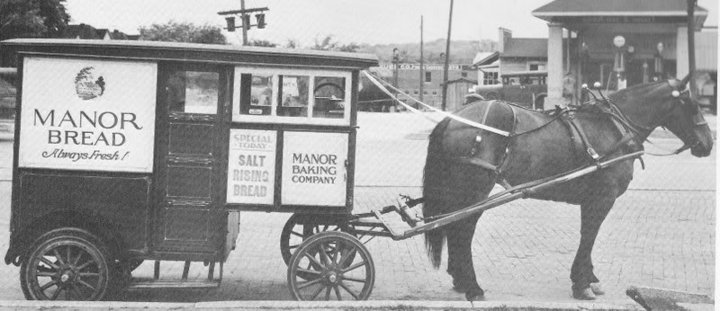
breadwagon

My research has discovered that Mrs. Patterson may have sold whiskey. While, flour mills were in operation in Independence the whiskey business was popular in Westport. By the 1830’s there were two-million people in all the Missouri Territories. The earliest census of Westport stated that there were 12 businesses, including one Indian owned trading post. Nine of those businesses were taverns or trading posts.  Men like John McCoy, had a combination general store, tavern, home, and post office. The women of the time ran businesses, too. These businesses were often, boarding houses, or the women sold fresh bread.

A priest traveling in 1840, to the frontier town of Westport noted that during his travel in the Missouri wilderness, he encountered an abandoned cabin where a poor Indian woman had died a few days earlier. Imagine Westport, where Indians with shaggy ponies tied up by the dozens to poles along the houses and fences of Westport Road. Indians, with shaved heads and painted faces, other Indians with long flowing locks and a few wrapped in blankets, all strolling down the streets and lounging about the shops. Also note, it was illegal to sell whiskey to the Indians.

It is my belief that Mrs. Patterson or her sons ran a tavern on the west of end of town, and sold Whiskey to the Indians. Pieces of history indicate that this building I call home, was once that structure of an old Westport original tavern.  After Kelly’s Tavern burn to the ground as a result of a kitchen fire, men started to remove the old wooden buldings. One owner sold his old wooden tavern building for as little as $5.00.  Several stories indicate that two-story buildings were rolled along Westport road on huge tree logs, pulled my mules. Logs are still under my house, to this day.

Mr. Kelly, a prominent tavern owner, lost his first wooden tavern, at the corner of Westport Road and Pennsylvania Ave., to a fire. Irishmen brought with them a great skill for brick and stone. He hired many talented Irishmen to build a brick tavern on the corner; where it is still in operation today. Kelly’s Tavern in Westport is the oldest surviving tavern in Kansas City. I loved drinking and dancing there in my 20’s (in the 1980’s). Every college kid, from far and near has partied at Kelly’s Tavern.

Other shop owners were jealous that Mr. Kelly had such a fine brick establishment, that many replaced their taverns with brick also. Although, the paper trail ended regarding the purchase of the building and moving it down the street, I believe that a man like, Mr. Harris gave or sold the building to Mrs. Patterson or one of her sons or to someone who rented land. Because the building sits on the plot of land once owned by Mr. Patterson, at the corner of Mr. Harris plat. Later Mr. Vogel purchased all of the Patterson’s land.

My house is about 200 yards from the Kansas Indian Missionary and Schoolhouse. The Indian School is now a museum and tourist site. It isn’t possible to walk to the missionary school from my house today, because tall, modern, cement, stone and brick buildings line the roads and form multiple blocks that create a barrier where the wilderness once allowed a path. The local newspaper of Old Westport, reported that a “particular tavern not more than 200 yards from the Indian Mission was suspected of selling spirits of alcohol to the Indians and contributing to the derelict behavior of the savages.”

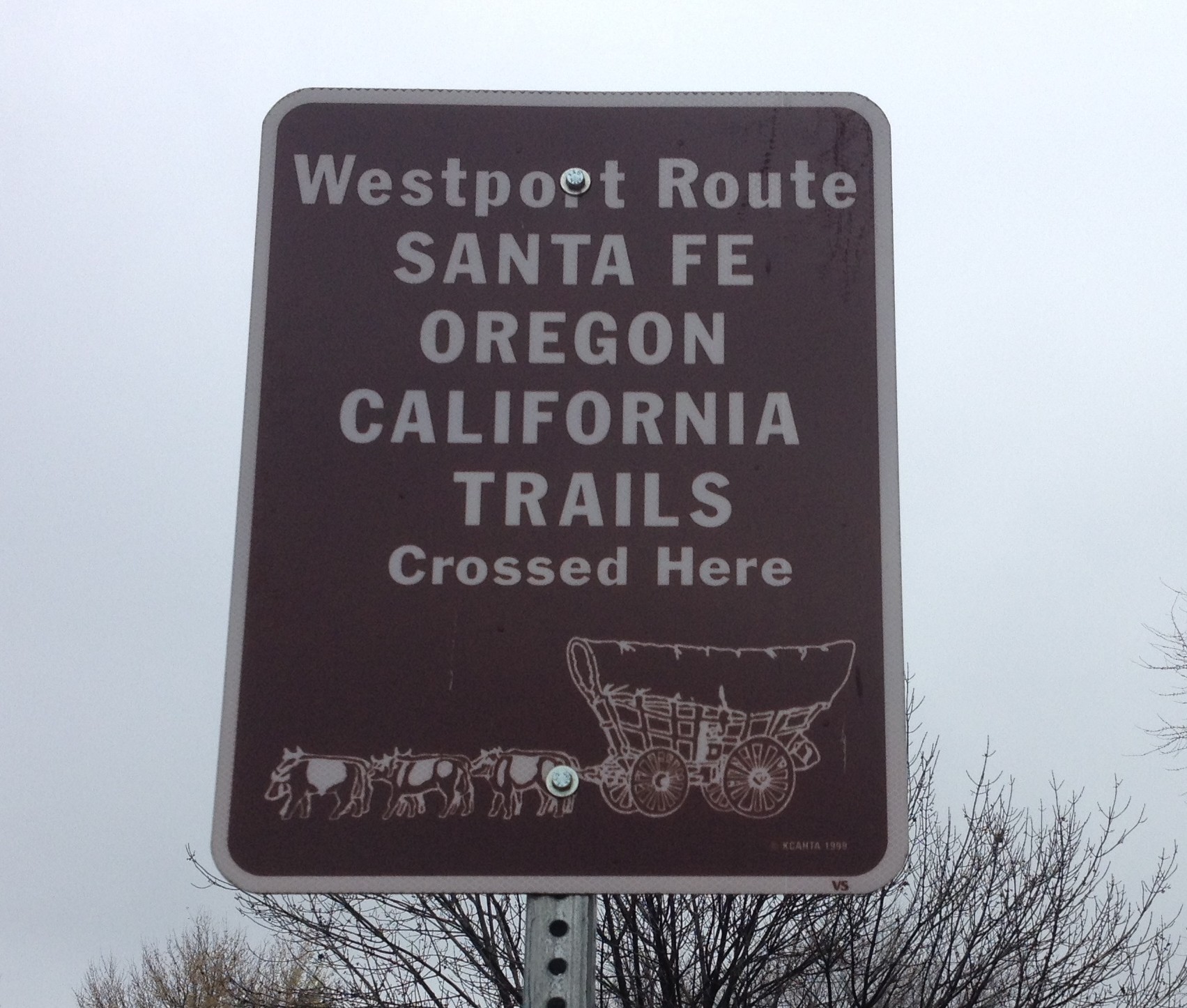
westsign

I live in one of the oldest wood trading posts, remaining, since the days of the pioneers. It was the last place to stop for provisions on the way west, and the first chance to buy a beer after a two months cattle drive on a dusty Santa Fe trail. (1822-1880)

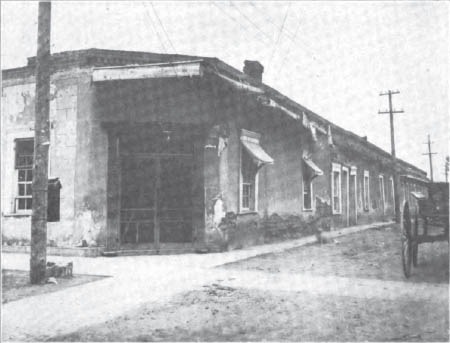
1909 Grocery store.
1909 Grocery store.

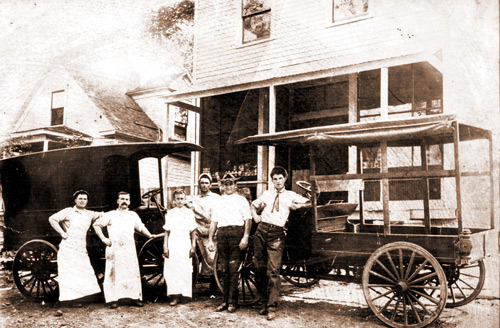
A boy, as tall as the gentlemen he poses with, stands in front of the grocery store in a picture, from the year 1909.  That young man was 98 years old, when he shared his accounts of the property. He lived up the street from us. He gave Bob, that picture of our house. The man had worked there, at the time of the turn of the century.  As he tells it, his family owned and operated the grocery store.  When the property was first built, the Santa Fe trail and cattle drive came through Westport.  This property, was the last post to buy something for settlers leaving town and the first place the cowboys saw, coming in.
Originally, the two-story building was fifty-yards up the hill. There was a pond at the current spot of the residence. Once the pond drained down to bed rock the house was set squarely by the road. The house was set along the far side of the pond, by engineering logs under the building, and dragging it down the hill with mules. The dirt foundation was replaced with cement, sometime in the 1980’s. In order to pour the foundation, the house had to been raised, exposing the huge logs for the first time since the logs were used to move the structure in 1855.

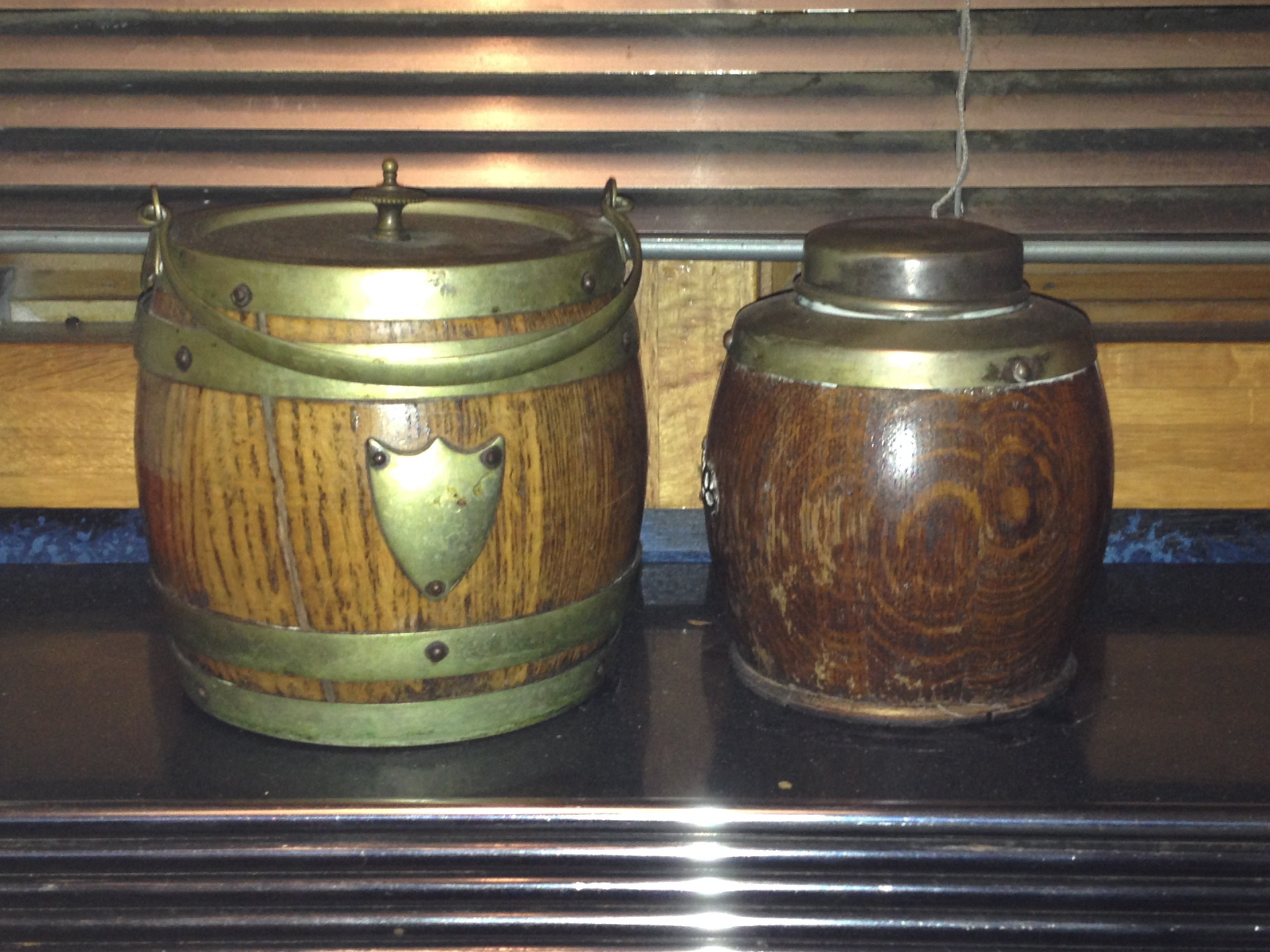
Pioneer lunch pail and coffee thermos

During the renovations that began in the late 1970’s,  a portion of an old dirt road and cobblestone curb was discovered in the backyard while Bob was landscaping, along with old medicine bottles and whisky jars. The Five layers of roofing and petrified wood on the house, provided an architectural manual of the different carpentry techniques used, as each layer exposed the years dating back to 1860.

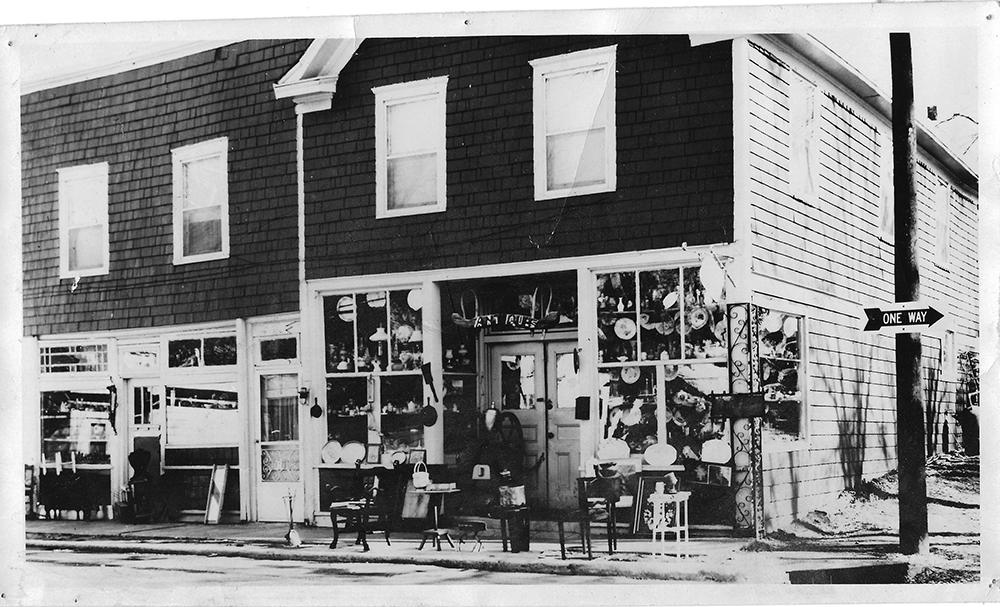
1960 Antique Store
1960 Antique Store

In 1860, the place was a  tavern, by 1909 it was a general store. Shortly, thereafter if fell into the hands of a contractor. By the mid-20th century the property had seen its best days gone. In the 1950’s, it was owned by a junk dealer who had the place packed to the ceiling with antiques and had two rental apartments upstairs. It was in that condition that our good friend, Drake, acquired the property and started those late 1970 renovations. He needed a commercial building for, Drake Design, a company that made fiberglass molds for the auto industry.

2008 Law Office
2008 Law Office

My husband Bob, bought the property from Drake. After 12 years of solo labor, Bob, was able to convert the house into its present condition and design. Bob has lived here for over 30 years, practiced law, worked on his art, and rehearsed a band or two. I have lived here for five years and absolutely love the place.

1867
1867

The original building was a rectangular, 2 story building with a large main room on the first floor.  In the late 1800’s an American Indian man, who owned the trading post/tavern, enlarged the building on the north side, doubling the size of the  building to 5000 square feet, utilizing a slant in the roof for a lodge pole, the technique matched the traditional structures built by his tribe.

Old Santa Fe Trail. 45th street facing west toward, Bell Street.

During the spring and summers of 1852- 1855, over 90,000 head of cattle traveled the by-way each year. The Stockyards operated in Kansas City’s west bottoms from 1871-1991. Once the railroad was installed it became the main means of transportation after 1870. These events had a significant impact on my house, the trading post, and its history.

Standard
Art, blog, History, Kansas City, Story, Uncategorized

My House The Trading Post, Garden of Eden

Garden of Good and Evil

Garden of Good and Evil

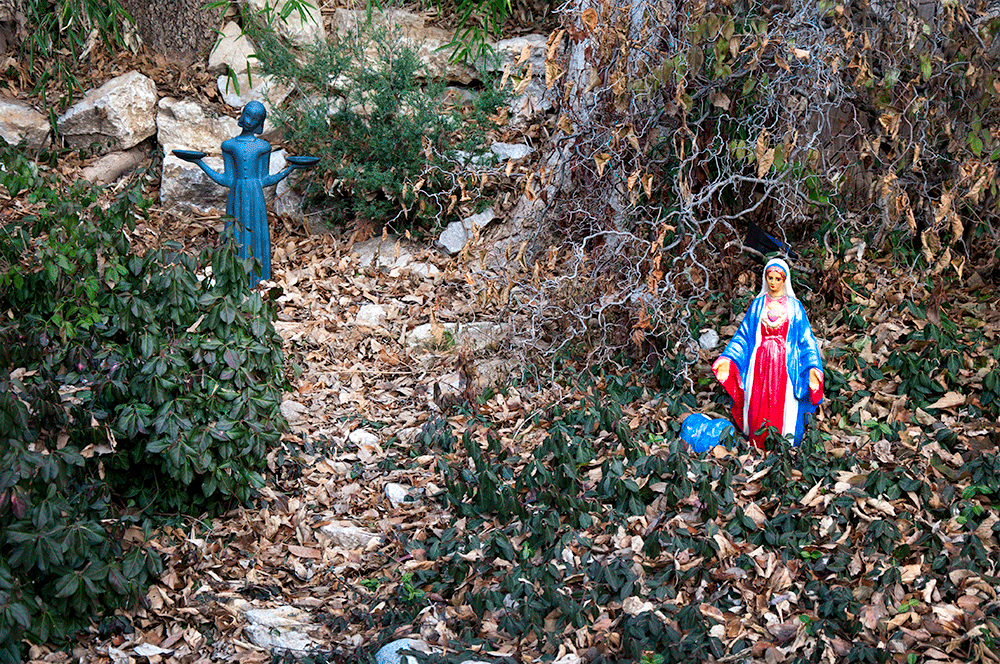
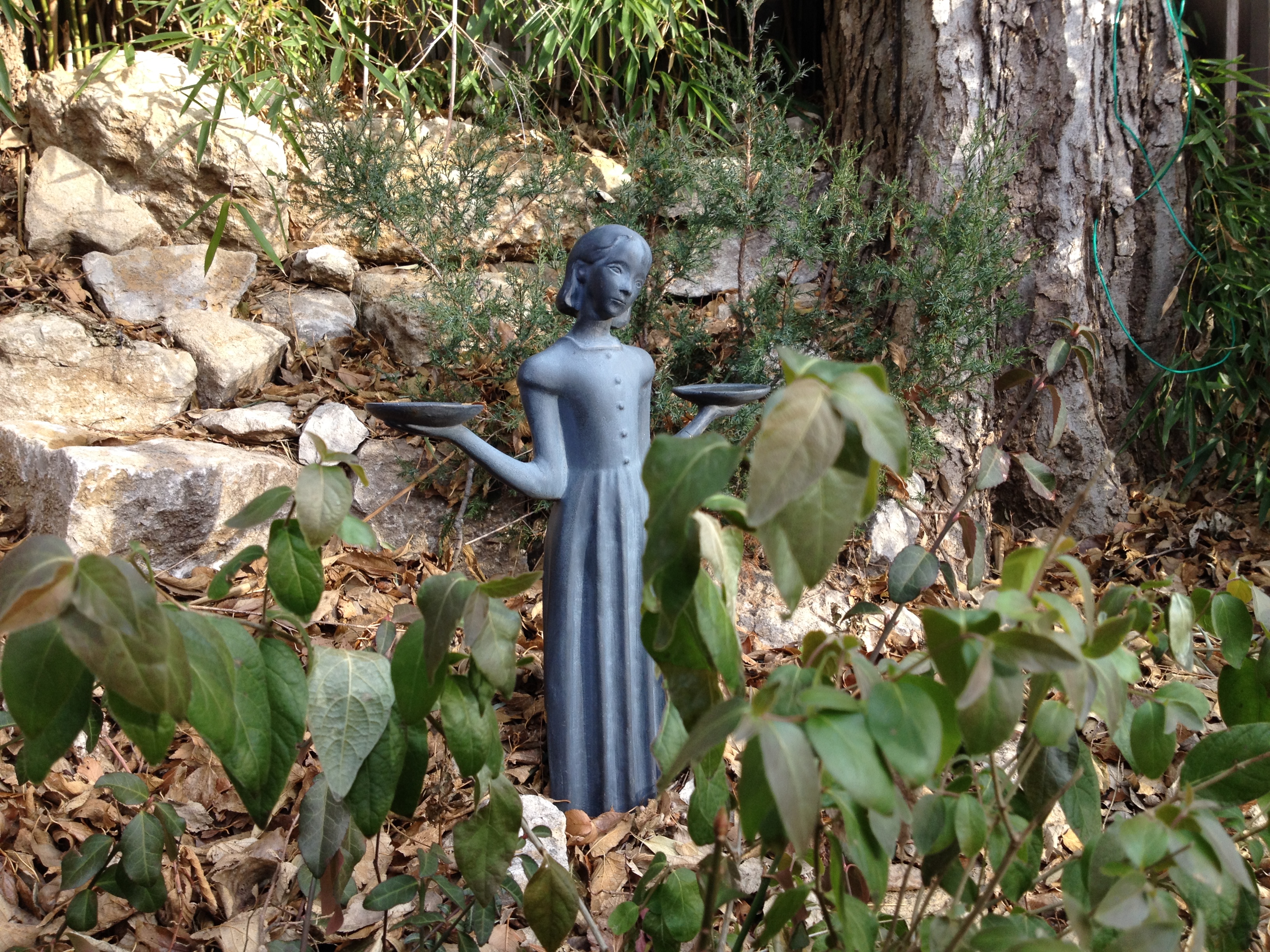
God expelled the first humans, from the Garden of Eden, and placed a mighty angel at the east of that garden…..”to guard the entrance to the Tree of Life.” The backyard of my house, a pre-civil war trading post in Old Westport, resembles what the founder, Joseph Smith, of the “Church of the Latter Day Saints,” refers to, in his new understanding of Genesis, as the location of Eden. During his trip through Westport and Kansas City in 1831, he had a revelation regarding the location of Adam and Eve’s first garden.

The old tree that grows in the backyard, we call, the garden of good and evil. Gazing at the tree will make you think you are near the entrance to the garden man was banished from.  A hole in the tree has fascinated our pets for years. Something is down there, the dog and duck haven’t gotten it yet, but continue to bark a warning at the tree on a daily basis.

IMG_2163

When Westport was young, Joseph Smith and his followers chose this area as their new, “Zion,” as they termed it. It is said that the Mormons, were first run out of New York and Pennsylvania, then organized a headquarters in Ohio, in the year 1831. That same year, the “Church of Jesus Christ of Latter Day Saints,” established missionaries to explore Missouri. The most developed city of the frontier times, for the new explorers, was Independence, Missouri. Joseph Smith and his followers declared the city the site for their “temple” and claimed God had selected the place as the “gathering place for his Saints to prepare for the second coming of Christ.” Since then, many proselytized Mormons, have come to Kansas City.

The Mormons brought with them a printing press and started a monthly news paper called the Evening and Morning Star. The newspaper began each issue announcing the Mormons were a “sect chosen by the Lord.”  They also started a weekly publication called Upper Missouri Advertiser. Each article published, ripened a growing hatred towards the Mormons. In the summer of 1833, the citizens of Jackson County, decided that they had to take matters into their own hands against the “pretended religious sect” of Mormons.  At least 700 citizens felt they had to protect society from the evils that the religious sect inflicted upon the community. A mob formed, willing to rid the Mormon immigration peaceably or forcibly. The printing office was destroyed first.

The Jackson County citizens did not see a reason to seek the arm of the law in Missouri. The Mormons, on more than one occasion, had printed Missouri’s liberal Constitution granting Freedom of Religion. The Saints were inviting followers to establish homesteads in the Kansas City, Westport, and Independence area.  The citizens wanted a sufficient solution to rid themselves from the deluded fanatics, pretending to hold personal communication and revelations with the most high God. The behavior of the Mormons and claims of their leader’s direct messages from God, along with the increased migrations of settlers to this area, seeking this new religion, turned neighbor against neighbor.

In those days, when the distances were all different among the hills and prairies, many lives were lost. Without any legal authority, innocent men, women, and children were shot, stoned, and clubbed to death here in Westport and throughout Jackson County. Including a sick women who sat up from her bed, possibly brushed open the curtains to investigate the noise, and was shot in the head. She had no weapon in the home, clearly an innocent bystander. The local officers were appealed to by the Saints, but they did not get any justice from the courts or county officials.

During the Winter of 1833, a group of men gathered in a Westport trading post and general store to plan another attack on the Mormons hiding out at an adjacent settlement on the Blue Valley River. Most of the Mormons had already started migrating to Illinois in small groups. When the last group of Mormons heard that the townsmen were planning another raid they tried unsuccessfully to hide in the corn fields south of Kansas City. They were killed and wounded. The Mormons were driven from the county. The work of the mob was complete.

Unknown

The Mormons left Missouri, by 1838, and fled to Illinois. In 1844, Joseph Smith was murdered by a mob in Illinois. Smith’s son, lead the thousands of followers into the desert and settled in Utah.  In 1860, the followers of Joseph Smith, became “The Reorganized Church of Jesus Christ of Latter Day Saints.” A sect of polygamist branched off from the church, their doctrine was introduced by Brigham Young.

The Mormon faith continued to grow and they eventually returned to Independence, Missouri. The church’s missionaries reached the Polynesian islands of Hawaii which have brought many Samoan families to our community. Westport’s business owners include Bob’s good friend and hair stylist, Eddy Ahloe. Eddy, has retired his large upscale beauty shop, that was once popularly located on Westport Road, to a simple part-time operation from his home. He came to Kansas City to take care of his parents who moved here to be close to the “Latter Day Saint” Temple in Independence, Missouri.

Tomato.
Tomato.

In the Spring something wonderful happens at my house the trading post. The weather warms up. Bob brings home fresh bags of garden soil from the local greenhouse, along with starter plants. Fifty-eight days later, we have tomatoes.

The first strawberry.

Inside large clay pots that sit on the wood deck stairs, strawberry plants were started a few years ago. Each season a few more berry’s are produced. The first year, we just got one. There are several months to wait before planting season starts. Wishing you many warm moments to share.

Well, there are blogs on gardening tomatoes that I added for your convenience.

I aways like to include related articles. The following link is interesting on the topic of Mormons and the Church of Latter Day Saints.

Thank you for reading my blog, My House The Trading Post.

Standard
Art, blog, History, Kansas City, music, photography, Story, Uncategorized

My House The Trading Post-On Stage

All-Hail Terrie All-Hail Terrie.

It’s all in fun.

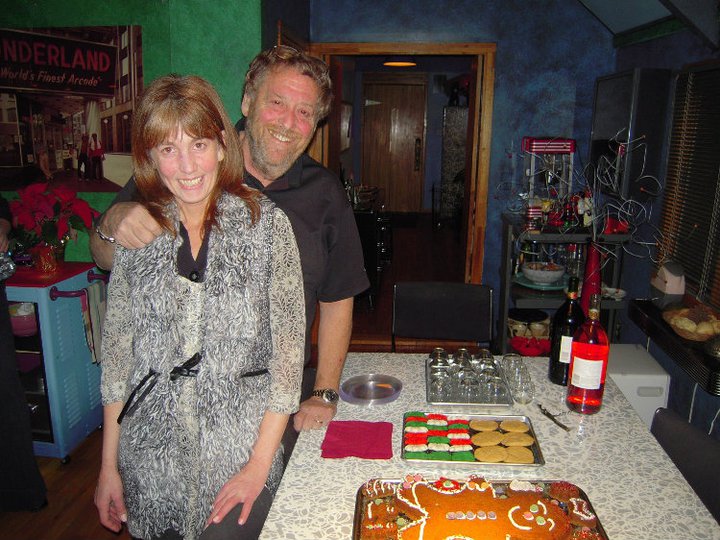
My house the trading post, today is a stage for Bob, and I. While I, make visitors feel welcome with a batch of home-made cookies, Bob, entertains them with his “licks” on the guitar.

Treats

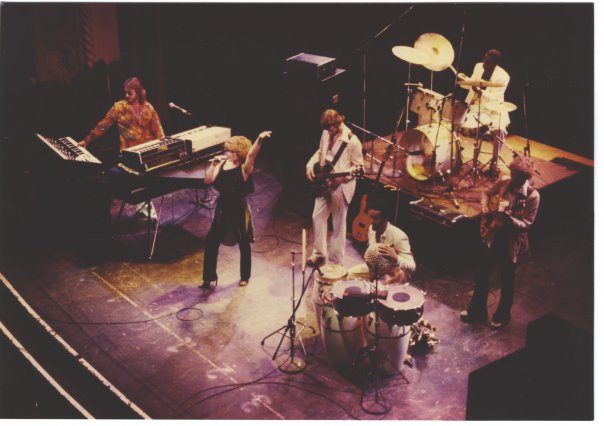
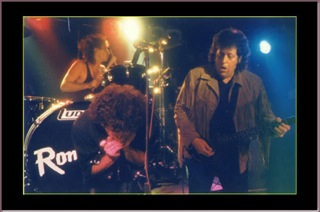
In 1967, Bob was part of a band called, The Horde. The Horde recorded a session in Durham, North Carolina while in college. That album was recently re-released this past summer. The band played gigs at numerous universities. They have been called the most exciting mid sixties garage band to ever be discovered. They starred at the usual teen dance clubs, Fraternity parties, and Student Union dances. The played songs like, “Paint It Black.” Which starts with Bob playing the guitar solo. The guys were considered hippies, traveling all over the place playing the ‘British invasion’ influenced music. They liked the raw in your face blues, filtered through British pop.

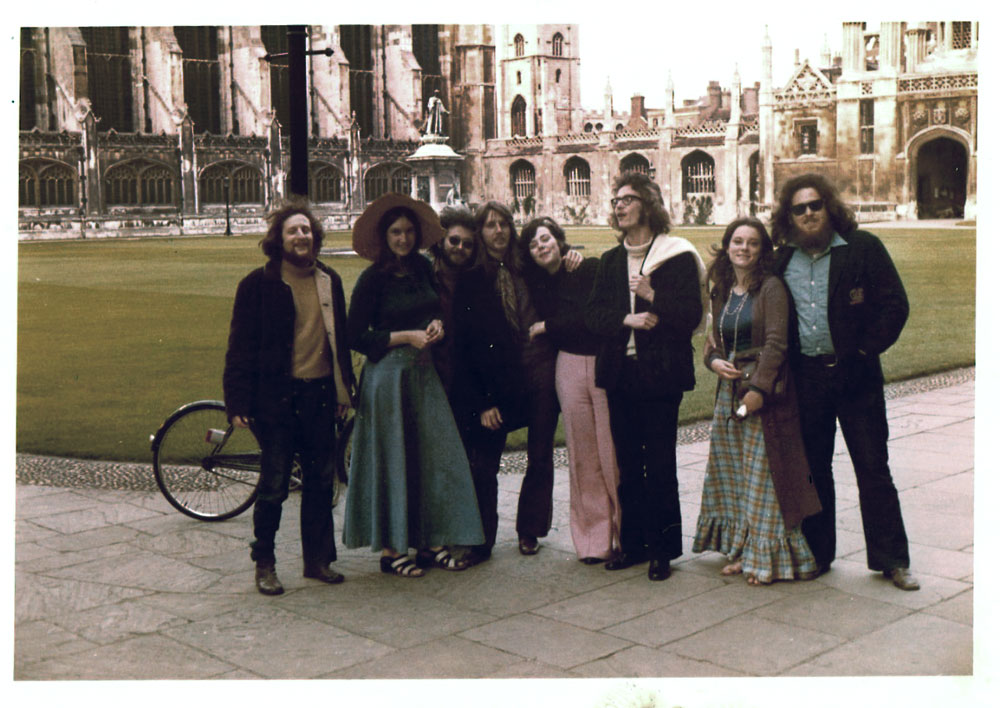
Cambridge, 1970 Cambridge, 1971

After the demise of the band the group went their separate ways. Bob graduated from college and went to New York to go to Columbia University Law School and later to Cambridge University, England. He now practices criminal law and family law.

7530_164815541017_718256017_3611910_4421384_n

He continued to play rock and roll and other music venues through the years.  He had a band once called the, “Bell Street Blasters.” With the Bell Street Blasters he played theater and stadium level gigs appearing in shows with B.B King, Johnny Winter, Stevie Ray Vaughn, Ray Charles, and others.

Press Buttons Firmly, by The Horde, Vinyl &CD. Price: $23.99 Press Buttons Firmly, by The Horde, Vinyl &CD.
Price: $23.99

During, the past summer, twenty-five brand new vinyl, The Horde, albums arrived, with two-dozen CD’s. They sit behind the display counter in Bob’s law office. The album’s public recognition is a little late, only forty-six years, too, late. Very, very few people out there are buying the Horde’s album, “Press Buttons Firmly.” A song titled after the guys noticed the message on the juke box in a tiny coffee shop on campus.

The Romantics. Bob, pictured on right. The Romantics. Bob, pictured on right.

North Carolina, in the sixties, was the deep south. The music the Horde’s were playing didn’t live up to the soul music country’s expectations. Bob and the band members, complained that the crowds constantly requested the song, “Stubborn Kinda Fella.” An incident the guys still talk about, is when a group of frat guys got fed up with the hippy band, and headed for the stage. Their drummer stared the angry mob down as the rest of the guys escaped. Take the time to listen to The Horde’s songs, amazingly good.

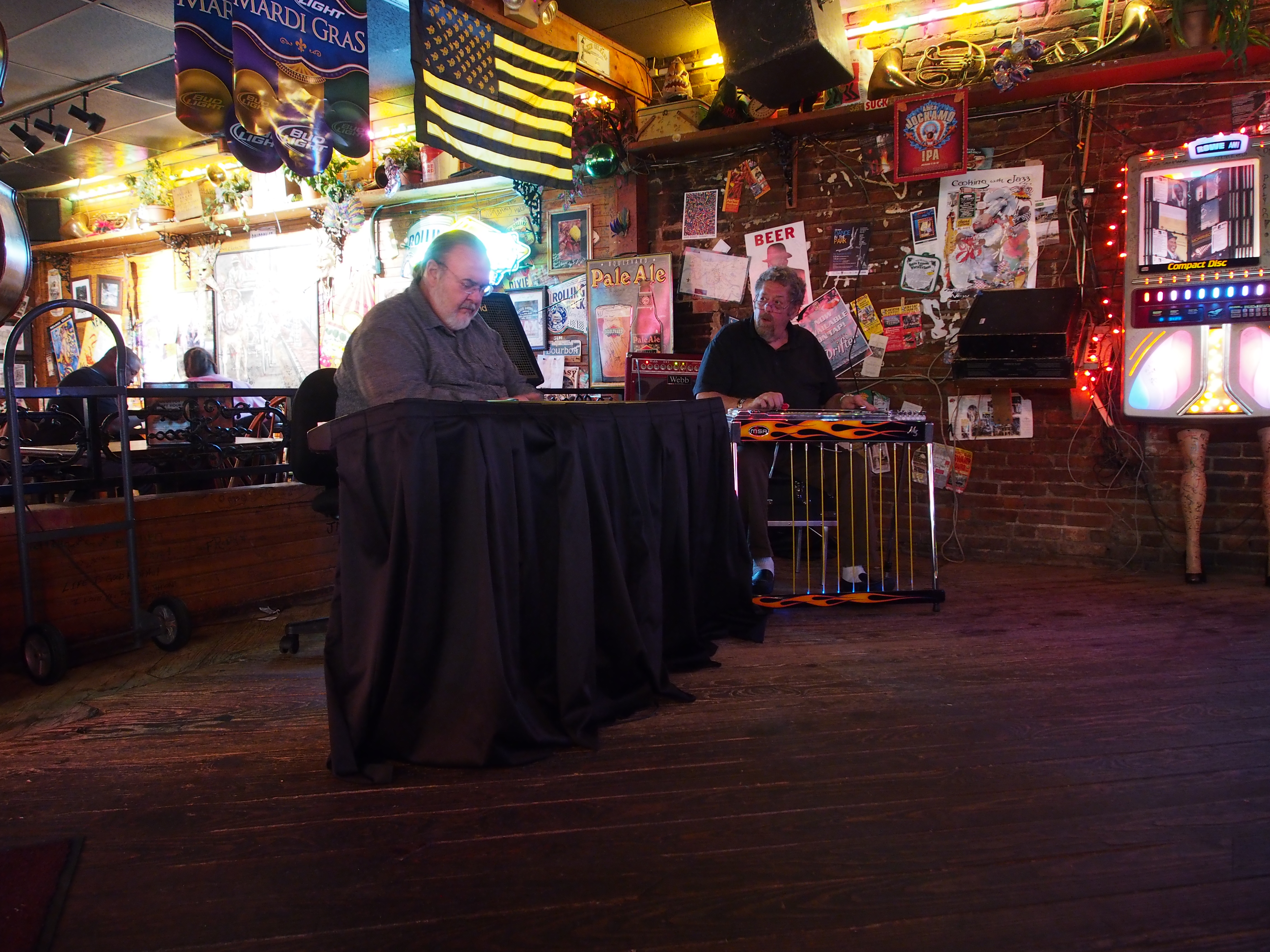
Max Groove and Bob Simons appearing at JAZZ on 39th and State Line Road. Max Groove and Bob Simons appearing at JAZZ on 39th and State Line Road.

Today Bob plays jazz and country gigs on pedal steel guitar. He has been appearing in duos with Billboard charted jazz keyboardist Max Groove. Together they play Jazz R&B or original New Age Jazz. He is a talented musician who mostly jams with friends.

If you are looking for a unique gift for a music lover, or collector, please consider, The Horde, album, “Press Buttons Firmly.” I highly recommend the album, Break-A-Way-Records did a marvelous job remastering the album. Someone out there in the world actually owned the orignal version of the recorded songs and they put them on YouTube, that can be sampled at:

http://www.youtube.com/watch?v=XZ6qQAhgzG4&feature=relmfu
http://www.youtube.com/watch?v=zvBoPSZ6Hnc&feature=relmfu
http://www.youtube.com/watch?v=UsgIFrpdi7I&feature=relmfu
http://www.youtube.com/watch?v=mx5bSt7Y6Yc&feature=relmfu
http://www.youtube.com/watch?v=ITxBi-K38vc&feature=relmfu
http://www.youtube.com/watch?v=X4hvHxk8zBw&playnext=1&list=PL0qGfMEO0Ns-4NmFHT8YyAU0CR5tx-2mS&feature=results_main
http://www.youtube.com/watch?v=f7PsyHJkNiM&feature=relmfu
http://www.youtube.com/watch?v=ZExhskQR0fI&feature=relmfu
http://www.youtube.com/watch?v=r6c_i7y4-PM&feature=relmfu
http://www.youtube.com/watch?v=xUXob71ctIM&feature=relmfu

The original 1967 -record of The Horde last sold on ebay for $1800. There are only 25 copies of the original studio recording. The new album is also available on Amazon for just, $23.99.

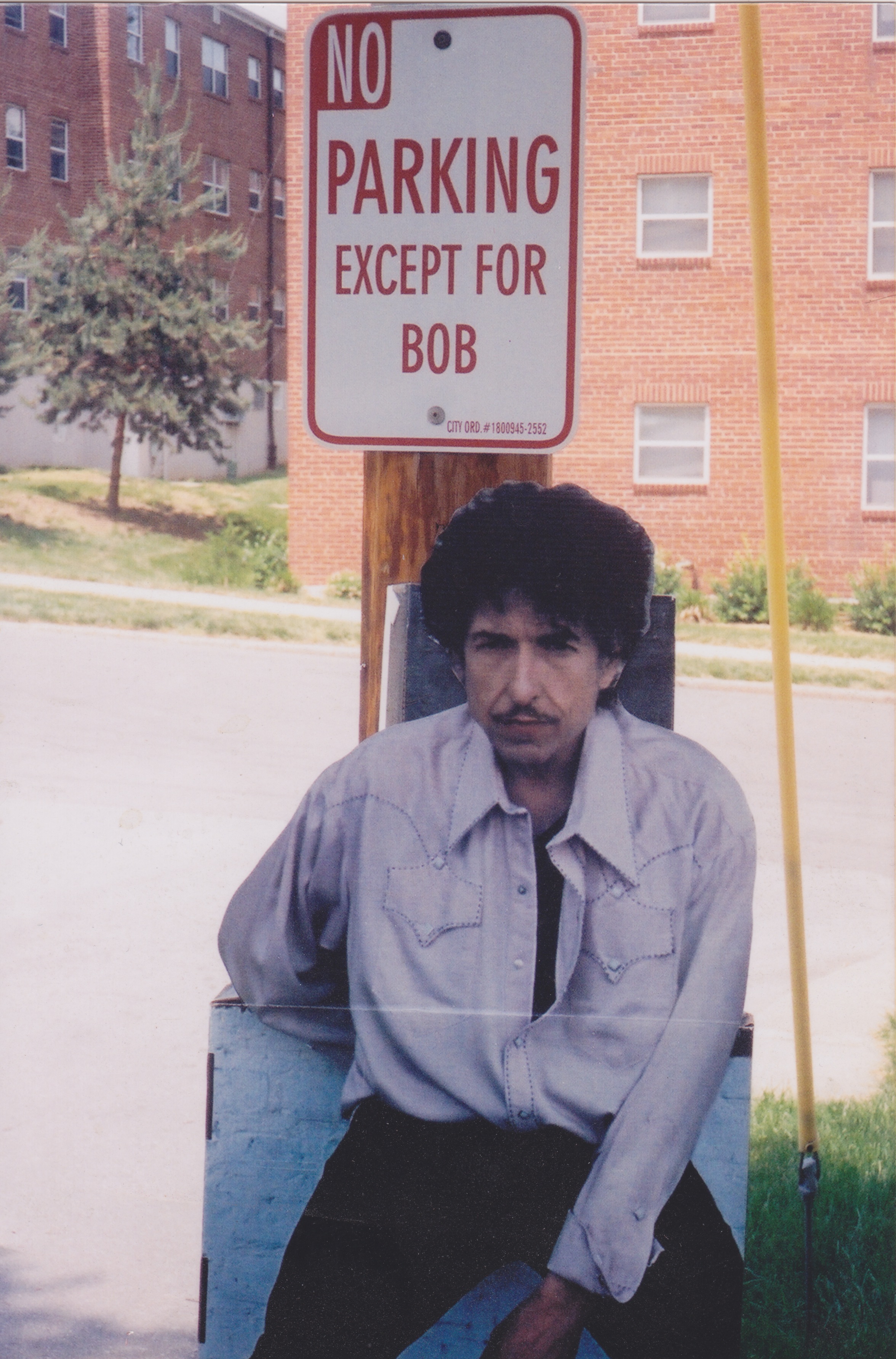
Bob Dylan
Bob Dylan

The routine at the house includes watching X-Factor. Tonight, like many other nights, I was enlightened by a brief music history lesson given by my husband Bob. Now mind you, I have heard of none these individuals or the songs. The song, ‘Hallelujah’ was song by a contestant on tonight’s X-Factor, a televised talent contest.

Leonard Cohen, a musician in the Music Hall of Fame who also received three Juno Awards nomination, got his start in the music business in 1967. Cohen is credited as the singer and composer of ‘Hallelujah.’ One of his earliest hits was with folk singer, Judy Collins, for the song, ‘Suzanne.’ Bob made me watch a YouTube video of this act (while I was trying to enjoy the X-Factor show).

In 1967, Cohen moved to the United States to pursue a career as a folk music singer and songwriter. During the 1960s, he was part of the Andy Warhol’s “Factory” crowd. According to Wikipedia, Andy Warhol speculated that Cohen had spent time listening to Nico in clubs and that this had influenced his musical style.” His song ‘Suzanne’ became a hit for Judy Collins and was for many years his most covered song. His song, ‘Hallelujah’ found greater popularity through a cover by John Cale.

The New York Times praised the song ‘Hallelujah’ in a review, noting that “Cohen spent years struggling to write the song ‘Hallelujah.”  Many singers have covered versions of the song. There are over 300 versions known. It is often called one of the greatest songs of all time.

John Cale was a member of the Velvet Underground, an American rock band, active between 1964 and 1973. The band was part of the first real scene of the high literature culture of Andy Warhol. These people were the hippest of hipsters. The Velvet Underground was formed in New York City by Lou Reed and John Cale. I believe, Nico was also a singer and songwriter for the band.

Lou Reed was a frequent performer at ‘The Factory’, a studio owned by Warhol. Andy often asked his assistants to help set up parties, which were groundbreaking assemblies of musicians, artist, hipsters, gay partiers, and drug addicts. The rented studio apartment in New York’s grubby 60’s neighborhood pre-dates the Studio 54 era. Bob tells me this, but as I always lived in the Midwest, and really don’t have a clear conception of Studio 54 either.

Bob says that Andy Warhol supported the music of the Velvet Underground and this influence started the avant-garde craze. Avant-garde is a term used in the fashion world, and when describing something that is ‘cutting edge.’ Andy Warhol designed the cover of the first album for the band, a banana. That banana is one of Andy Warhol’s most recognized artworks. It became the most popular album cover art of all time.

Lou Reed went on to write a song in 1972, called “Walk on the Wild Side” on his second solo album Transformer. Lou Reed had performed at Max’s Kansas City in New York and Studio 54, two of the most famous and treadiest clubs in New York.  Leonard was famous for his poetic song lyrics, ’Suzanne.’ Like singer songwriter, Bob Dylan, he was the poet of the time.

The song contest show X-Factor, has enlightened me to the history of old songs. From my husband Bob, I learn that he is often irritated that shows like X-Factor don’t actually acknowledge the cover songs properly. The old songs are, too often, credited to modern singers, like Mariah Carey, or to the last pop singer that sang the song. Passive television viewers, like myself, pay no attention to the originality of a song or who composed it. I usually don’t even have an opinion as to who sang it best.

While I watch television, I’m thinking, the judges are babies. The female judges on the X-factor wear a lot makeup. They represent youth and have a good game for knowing their own limitations and their wealth hides any immaturity. Simons Cowell has matured and he has been less critical of the young singers.

The whole time I am unable to actually hear the girls and boys sing on the show because in the background my darling husband, Bob has picked up the acoustic guitar and plays. Singing songs like ‘Wild Wood Flower.’ A song, I never heard before. He says it is the greatest country song ever.

I’ve heard it before, only ‘cause he sings it whenever he picks up the guitar. He knows other songs, and I like other songs, but that’s not what he plays. I like when he plays ‘Greensleeves, or  Jonny Cash’s, ‘Ring of Fire.’ My Lutheran upbringing loves to sing hymns like, ‘What Child is This,’ during the Christmas season. I happen to know Mary J. Blige is not the original composer of that song.

Once, Bob and I, recorded, ‘Ring of Fire,’ for our grandson, Eddie. On one of those recordable page books. Eddie, loves to turn the pages of the recordable book and listen to gran-ma and pawpa sing various folk songs. If you’d like, I’d be happy to make you a book; just let me know. We have a few for sale.

Typically, I don’t sing in public. However, I did sing in my high school choir. I have also, been known to take a shot of tequila and do a little goofing around singing. Last Halloween, at the Monster Bash hosted by a local Westport Tavern, I tried to perform an Amy Winehouse song.

tequilla

Standard
Art, blog, History, Kansas City, Story, Uncategorized

My House The Trading Post & The Phone

1940 Tax Assessor photo, kclibrary.org

Westport was annexed by Kansas City, in 1898, after voters approved it. The town of Westport would cease; but the residents gained better police and fire departments, street lighting and actual streets, and more schools. With the new streets came water lines and electricity. The phone, along with utilities, like water and electricity expanded from 1879 to 1910.

Novice inventors had been playing around with electricity since the 17th Century, for amusement and other zany purposes. It wasn’t until 1820 that a classroom experiment demonstrated an electric current down a wire could move the dial of a compass creating a magnetic field. The brilliant collection of inventions in the 1870’s connected technologies and resulted in the birth of the phone and many other must-have, necessities for life.

Small entrepreneurs started up electric companies.  Electric companies popped up in every corner. However, only the businesses and wealthy residents, in the core of the city could afford the new technology. Power companies consolidated and as another natural monopoly was created, municipal ownership and State registered companies formed. The city was able to provide essential services like electricity to everyone. By 1920, public power had raised the standard of living and brought electric to the rural areas and even to the poorest of households.

Although the concept of the telephone had been on the inventors’ desks since 1853, the telephone didn’t make an impact until electricity became available. In America we give credit to Alexander Bell and his partner Watson for the telephone, and Thomas Edison for lights. Alexander Bell was the first to make it to the patent office to claim the phone. There were actually many working on various projects that together with trial and error became the most used technology.

The house I live in operated as a tavern or saloon and dance hall until 1904, when the streets started to be paved. The neighborhood started to take on a new life. Instead of dusty cowboys needing to quench their thirst, development brought fathers and housewives with children into the tastefully attractive new homes being built. The history of this old Westport trading post building reflects the changes of the community at the time.

The Vogel family owned the land in 1879, acquiring it a piece at a time, from each of the adult Patterson children. Rachael Patterson had won her inheritance claim to the land in 1873. She was an old woman at this time and living with her daughter-in law North of Kansas City. The public tax records of that year indicate that Mrs R Patterson, widow, received $10 for the sale of spirits and rent. This may also mean, that Mrs. Patterson rented the building to Vogel and had to pay a tax because liquor was sold on the property. Vogel was the owner of the saloon at that time.

The Vogel’s had the Patterson farm until 1904 when they sold it to the Charter Oak Lot Company. While crews cleared the land for the new subdivision, the saloon became a spot for a liquid lunch or beer thirty (a phrase for a beer, thirty minutes after work shift ends).

In the last years of the saloon days, a telephone was installed. For the few residents that patron the bar, the phone was a means of messaging to the outside world. A new generation of patrons came to the saloon, he was the street contractor, the crews of men installing the plumbing, electricity, phones, and the tree cutters.The atmosphere wouldn’t have been anything to write home about. The light would have been dim, and the air stale with the smell of liquor and cigar smoke. Items like pickled eggs from a jar and a glass of cold milk might have been the only food available for a working man who might be waiting at the tavern for a call from his family in Illinois.

By 1906, there were 217 homes built on the Vogel land, owned by the Bargain Realty Company. With new residents moving in, the tavern lost appeal. The Vogel family abandoned the saloon. The building was once again sold. This time it became a grocery store. A convenient place for the 217 new homeowners to pick up an item on their grocery list. A mother could send her youngster off to the store with a handwritten note of the items she needed and the store clerk would fill the order and deliver the items himself.

Several men worked at the grocery store. The building was quite large, one large room on the first floor with a double door  entrance under a porch roof. Inside the walls were bare and simple planks of wood lay directly on the dirt beneath. The hum of a motor for the cooler to the meat counter rattled whenever someone stood on just the right floor board. The building, having been moved some 50 years earlier, would have started to sag in places.

Upstairs was divided. The owner rented an apartment to one of the men who worked behind the butcher counter. The other side, leading down to the grocery store, contained the refuge of the years, old bottles and crates, tools and other artifacts; plus the overflow of merchandise from the grocery store. The gentlemen who worked here were cheerful and chatty, they provided delivery service of their goods.

By 1930, everyone  in the neighborhood could afford to have a phone in the house, the store no longer served the community as a place to quench your thirst. The store owner didn’t know your name or let you use his phone for personal use. Outside the building stands a man holding a cardboard, five feet long, with the phone number of the furniture store that occupied the corner of 46th and Bell.

The forgotten wall phone
Pioneer lunch pail and coffee thermos
 Victorian lunch pail and coffee thermos
Standard
Art, blog, History, Kansas City, Story, Uncategorized

My House the Trading Post Welcomes Strangers

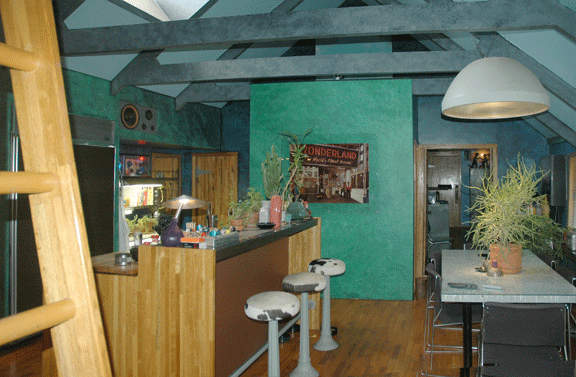
The Kitchen.  Bar stools from early days.

The Kitchen. Bar stools from early days.

A topic I am not comfortable writing about… is the lives of the slaves. I’ll discuss here under working class neighborhood. Nearly every family in Westport Missouri between 1830 and 1860, had two slaves per household.

I include this section as it is significant because on the map of Westport, in 1829, there are two spellings for the name Patterson; or there were two Paterson families registered living on the same land parcel. The map had the name Paterson, with one t printed in pencil. However, on all other documents regarding the land, the name Patterson, is written with two ts. The Census registers a black man, at the time as named, Paterson. The census also shows the Patterson household has eight members, with seven listed as white. Under slaves the box is left empty. The map shows a pencil drawing of a dwelling, which happens to have the shape of my two-story building. (The map is inside every book about Kansas City, or Westport- and available in real at the Missouri Valley Room).

Mr. A. Patterson and his family came from St. Louis Missouri, where they lived in an area with large plantations.  Patterson was also elected the Justice of Peace in Westport Kansas City in 1828. Before he died in 1930, he officially married two couples. One of those couples was the owner of a trading post. The other was the owner of a furniture store. After Mr. Patterson died, parts of his land were rented. Both a black businessman, as well as Indian, leased the land.

History tells us that black men and women adopted the last names of their slave owners. Occasionally, slave owners fathered children with the slaves. Accounts of slaves during this time, like Mammy Pleasant, tell stories of her reliance on powerful men like Judges, and her time spent between adjoining plantations in Missouri.

White families continued to hire full-time domestic help throughout the years of 1860 until about 1960. Many African-American blacks, at the time my house the trading post was build, were free. There may be a link between the Patterson family and the Paterson family. I would like to collaborate with someone who is an authority. A lot went on in the early days.

The African-American black men and women of Westport Missouri would have had various talents, like the culinary arts, and business skills. As a slave, they may have been sold many times and with each new owner they would have learned new skills. Taverns with a reputation for having an outstanding cook, could make a fortune.

The Slaves ran the kitchens, in the year 1853; the year this house was built. Freed slaves, often found themselves in position of servitude, even for a fee. It was a difficult chore for a single person to prepare meals without help. The kitchens would have consisted of an open fireplace with a huge pot hanging from a crane as the stove. The frying pans covered in suet. A pointed rod with an iron handle would be near by to hold meats over the fire. In the tavern there would have been one main open room with a fireplace at one end. That area would be known as the kitchen.

During the various years, there would have been no reason to keep an employment record for someone who came to the backdoor looking for a job. Those parts of history will be lost. In addition, it is fortunate that the wooden pre-civil war saloon has survived tragedy like fire. Many Westport properties were lost in those early years to fire.

Missouri had both slave owners and Abolitionists.  Gatherings in homes formed networks to support the antislavery movement. In 2013, a small town north of Kansas City uncovered a tunnel under their small city. The forgotten passage ran the length of the town, from the railroad station to the park. The park was once the location of a large university. I was driving through town when I noticed a commotion and stopped to hear the town gossip. No further news has been given the citizens. Such a passage could have been used for Abolition activities, also known as the Underground Railway, which provided the escape points from slavery.

The kitchen today, of my home, is beautifully modern. It is my favorite part of the house.

Missouri Plantation Recipe for Persimmon Beer, (1859, Mammy Pleasant)

Be sure the persimmons are fully ripe. Remove from them the stalk ends and the interior calyxes. Then mash the fruit and add enough wheat bran to make stiff dough. Form the dough into thin flat cakes and bake until crisp. Then break the cakes up into clean wooden barrels and fill them with water. Set the barrels upright and cover them with thin white cloths and set them in a place which is warm and dry. The cakes will rise to the tops and begin to foam. Three or four weeks later the barrels must then be moved to a cold place and wooden covers put on them. To make certain of success, toast dipped in yeast can be put into barrels with the persimmon cakes.

Nephew, Kyle

Nephew, Kyle

Standard
Art, blog, History, Kansas City, Story, Uncategorized

My House the Trading Post Blog Time

thelion

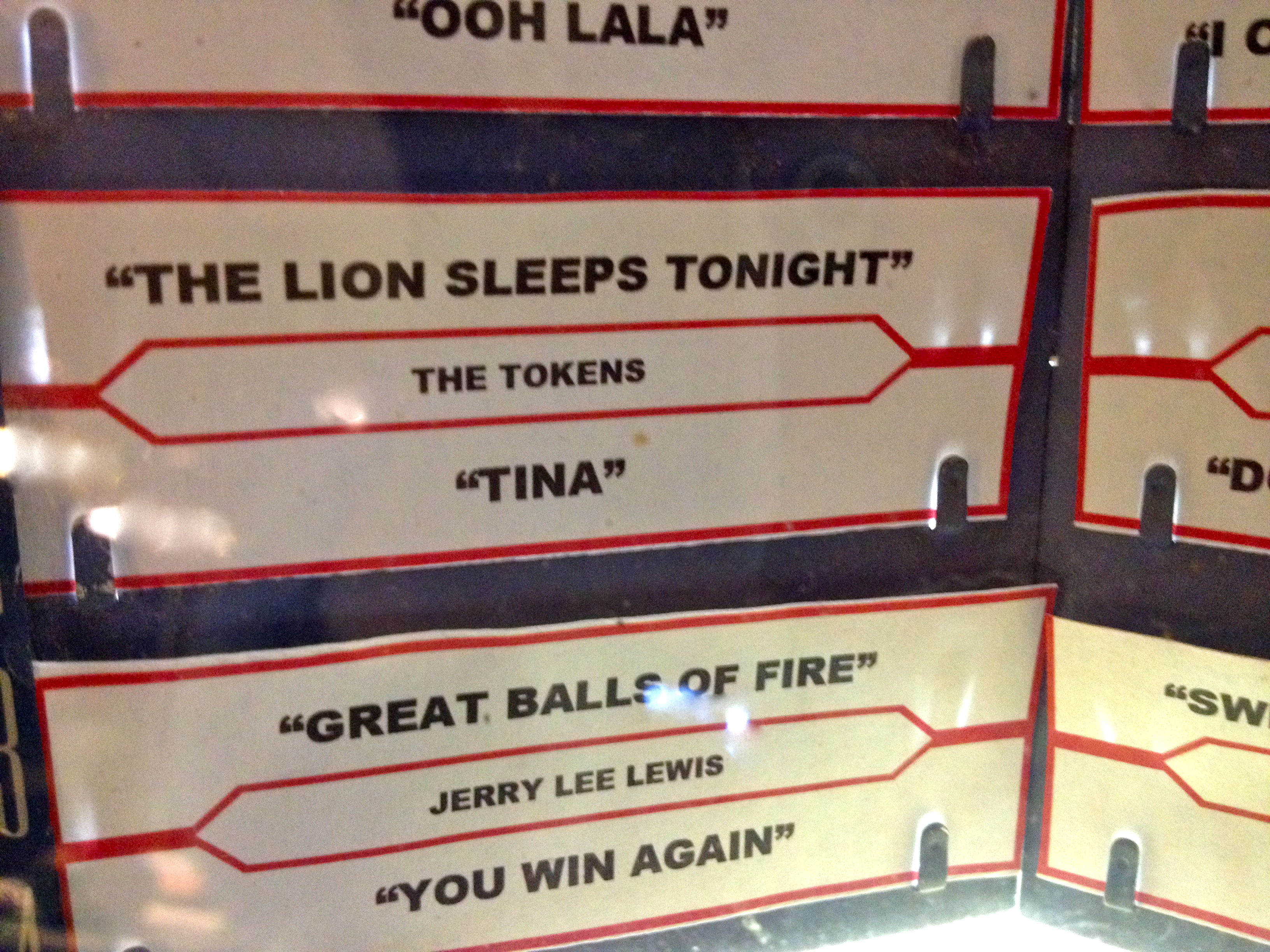
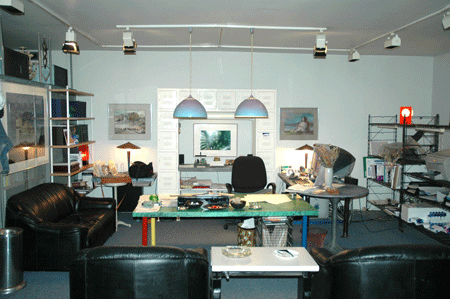
The change of season may bring the blues, but the treasures within this house can almost always brighten my mood. In my bed cloths I move from room to room in this huge saloon from long ago. I carry a load of laundry through Bob’s law office. I get the load in the washer. I drop a quarter into the juke box. A 1954 Wurlitzer plays my selection, “The Lion Sleeps Tonight.” With no one in sight, I dance and sing along.

Not your traditional law office

Not your traditional law office

A 1954 Jukebox, left behind by, plays only 50's tunes.

A 1954 Jukebox, left behind by, plays only 50’s tunes.

It is interesting to consider which characters that may have passed through the doors of this Westport saloon, or inhabited an apartment upstairs.  I truly believe that Doc Holiday, Bat Masterson, and Daniel Boone have been here.

I am also convinced that Ernst Hemingway had a friend who lived here (The boy shown in the B&W picture of the tavern in 1909). The boy in the picture continued to live in this neighborhood until the age of 98. I share many of his stories in this blog.  I do not remember the fellow’s name and I am not aware of his exact death (sometime in late 1990’s). If the man says he was friends with Ernst Hemingway, I see no reason why he should lie. There were lots of authors that have lived in Kansas City, he only mentioned being friends with Ernst. It is that old man’s recollection of frontiersman like Masterson and Boone that I write about.

Not everything I post will be part of the book, “My House The Trading Post, Its History.” The audience for my book are my friends and children, specifically, my grandson. The earlier items I posted presented more historically accurate information directly from the history books. The historic nature of this property has not been officiated, but a line of communication has been established with the National Historic Registry Board.

I know for a fact that Bob Seiger, Robin Williams, Rick Spring=+#, BB King, and a song writer guy from ABBA, John Luke Pontic, Pee Wee Herman, One of the guys from ZZ Top, Bonnie Rate and Jackson Brown, to name a few that have been here to jam.  The last group of celebrities were brought here by my husband Bob, who is a musician when he isn’t practicing law. In fact, Bob claims that right after Jackson Brown jammed in the house, he wrote a hit song about a mean lawyer, shortly after his visit here. Bob says his time spent with Robin Williams the comedian, had him in hysterics; they visited the US Toy Store for Robin to get some props for his act (appearing at the Kansas City Comedy Club). There wasn’t an isle in the toy store that didn’t put Bob to tears. A private, rehearsed comedy routine, a memory trapped in Bob’s head.

My husband Bob, would like to be a full-time golfer, but practicing law pays the bills.  The celebrities Bob knows are still alive. I won’t be writing much about their time here, because such information could be incriminating since it was a different era when they partied here.

Bob Simons playing with Romantics, pictured on right

Bob Simons playing with Romantics, pictured on right

1900 Saloon

1900 Saloon

Consider making a donation,   http://pbwckc.webs.com/donate

Followers needed and random ‘likes’ appreciated, even if you can’t make a donation.

Standard
Santa Fe Native Americans Santa Fe Native Americans4547-BellMy House

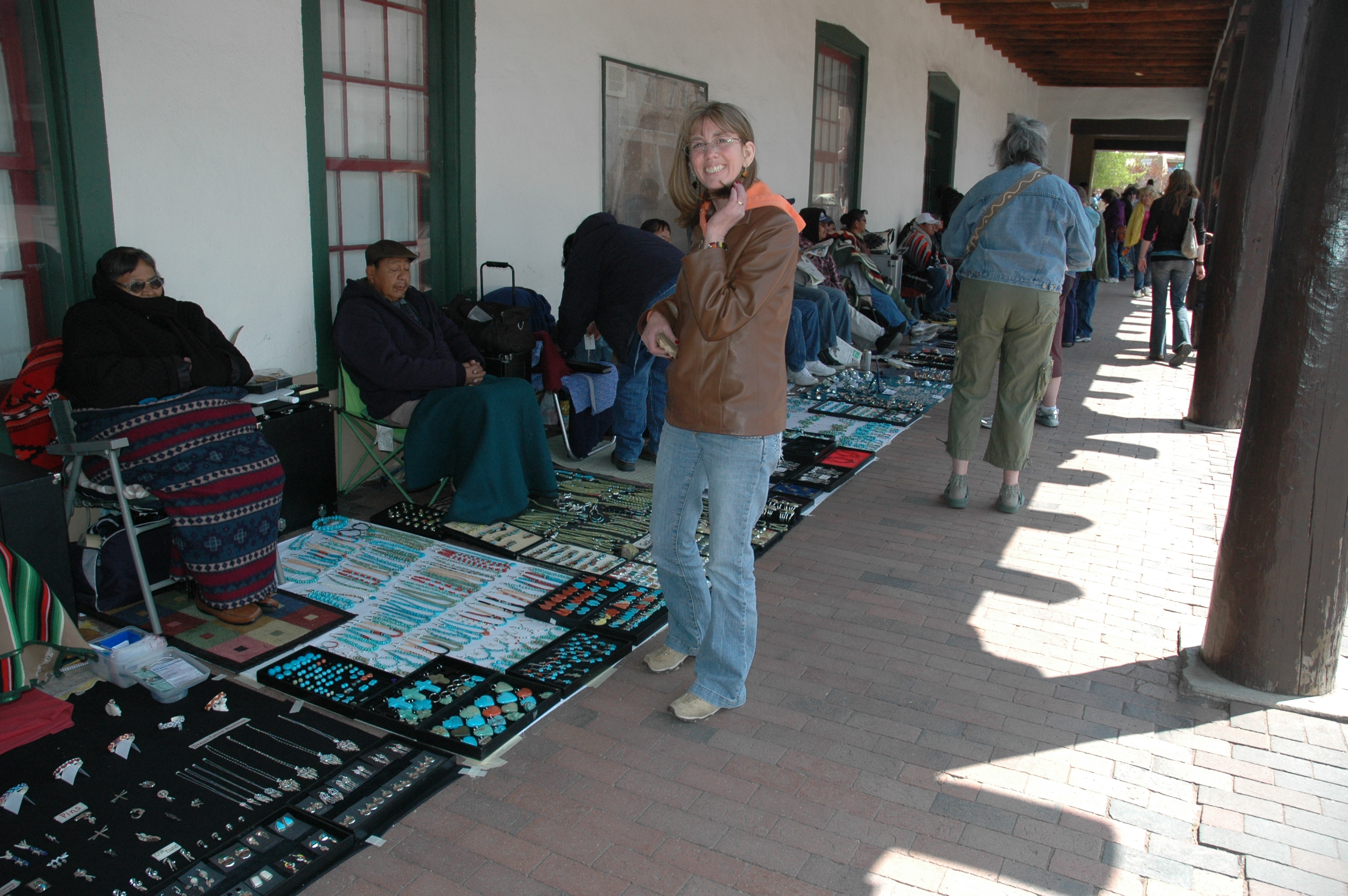
The Native Americans display their hand-made jewelry along the sidewalk in Santa Fe New Mexico. When I travel to New Mexico from Missouri, I like to imagine what the trip was like for the pioneers. However, my heart breaks when I visit the Indian reservations. I tend to buy everything they try to sell me.

My house once served as a trading post, owned by a man of Native American ancestry, at the time of the Santa Fe Trail. Westport Kansas City no longer has a Native American presence. The only hunting that takes place are by the shoppers that stroll by the brick buildings with awnings and neon signs.

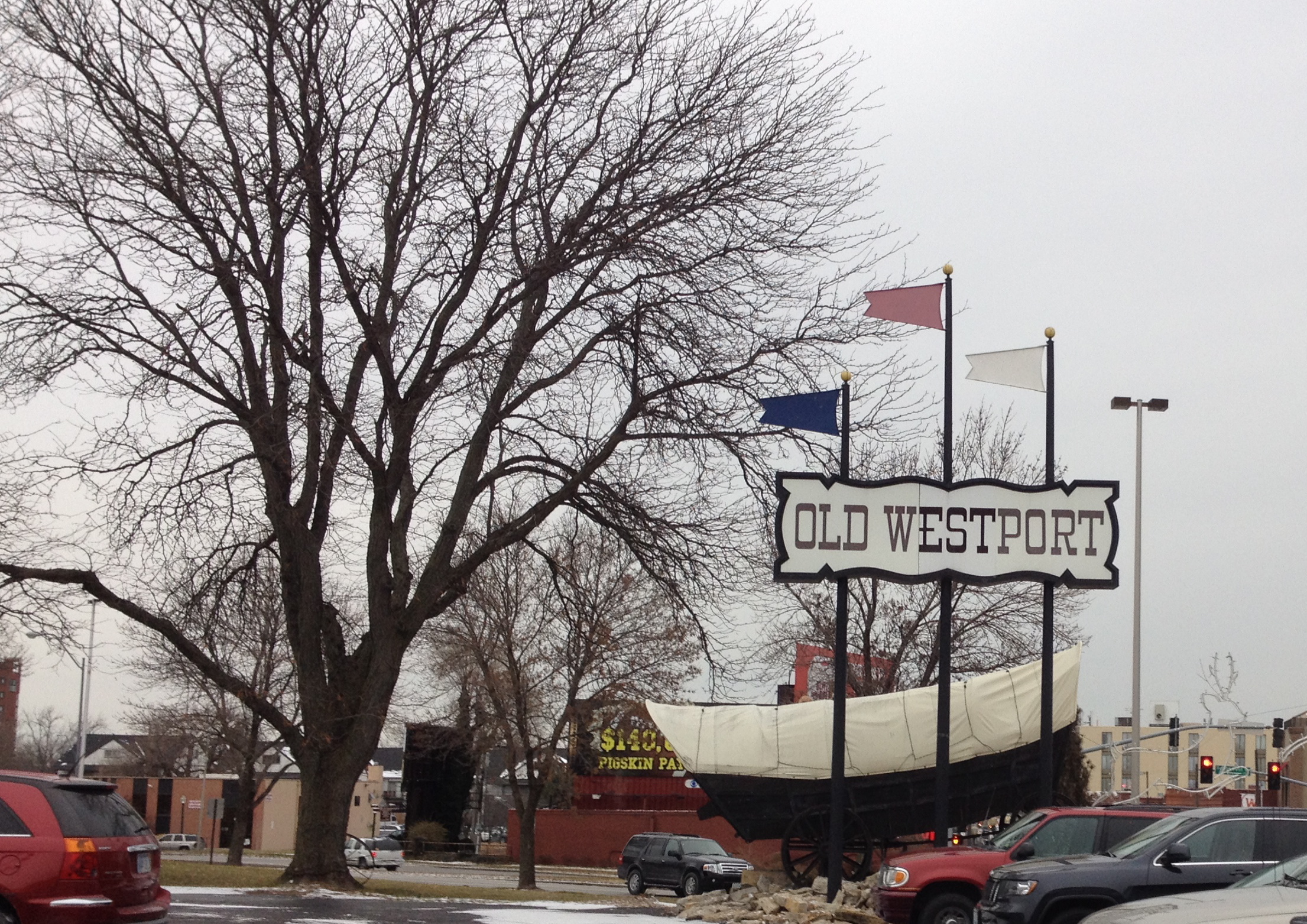
Old Westport sign at the corner of Wesport Road and the traffficway. Old Westport sign at the corner of Westport Road and the trafficway.

There are no tall buildings in Westport. At the corner of Southwest Trafficway and Westport Road, an old wagon is preserved under the ‘Old Westport sign.’ Although, the streets are quiet during the day, the days of gun-toting renagades are not necessarily gone. I was out shopping and saw a man bend over to pick up his toddler, and out poked his hand gun. At night, sounds of emergency sirens and train whistles echo. There are occasional gun shots in the night.

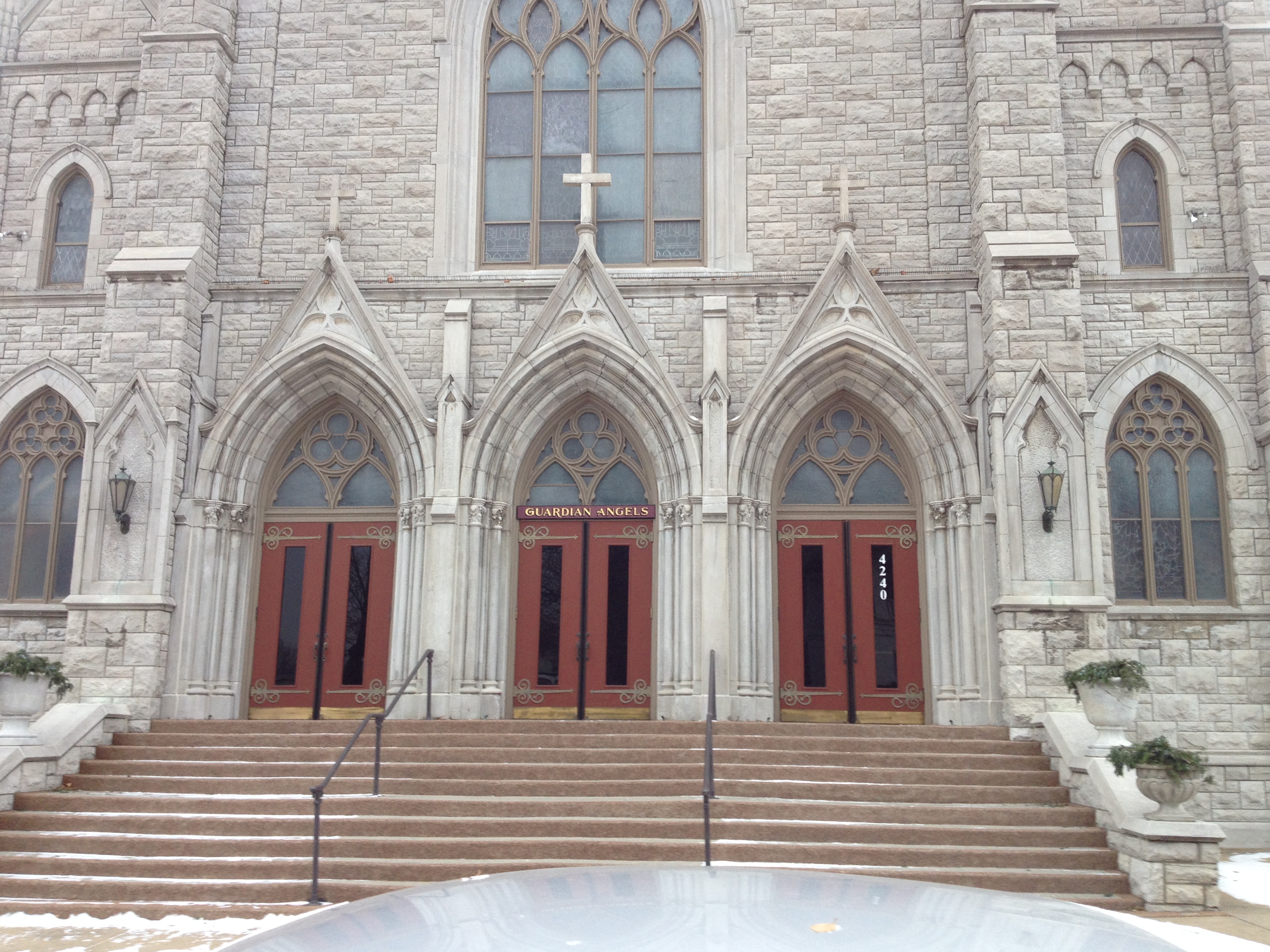
The police set up DUI check points at each end of Westport. Fools like my 20 something year old son, will try to run from the cops, if under the influence. I can’t tell you how many times I’ve gone out into the night to rescue him drunk hiding in the bushes behind the Catholic Church, “Mommy, come get me.” It is hard not to help when I actually hear the police sirens in my neighborhood, and the phone rings with my only son saying the police are after him. An unarmed party boy, he will never grow up.

The front of the Westport St. Gabreil Catholic Church The front of the Westport St. Gabriel Catholic Church
My son. My son.

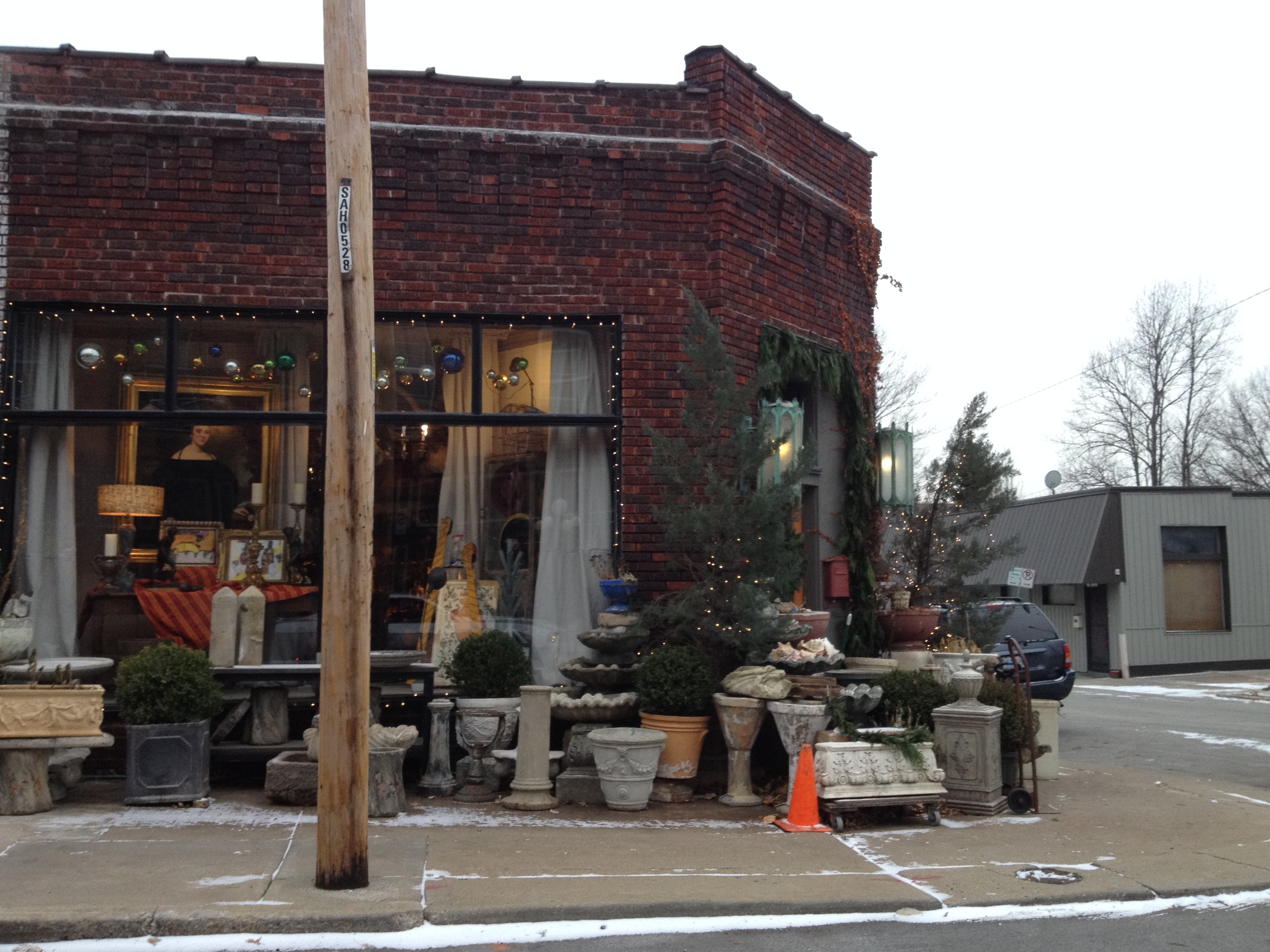
Young people come out at night to enjoy the music and dancing at the local taverns. Most of the bars serve food, and have bands play music until close. There are taverns along Westport Road, like Kelly’s Tavern, and McCoy’s Bar and Grill, which have been here since the 1820’s. Within walking distance from me is Cupini’s, an old Italian Restaurant and Market that makes fresh pasta daily. The trendy businesses are tattoo shops, psychic readers, dress stores, art gallery’s, art supplies, and antiques.

Antique Shop

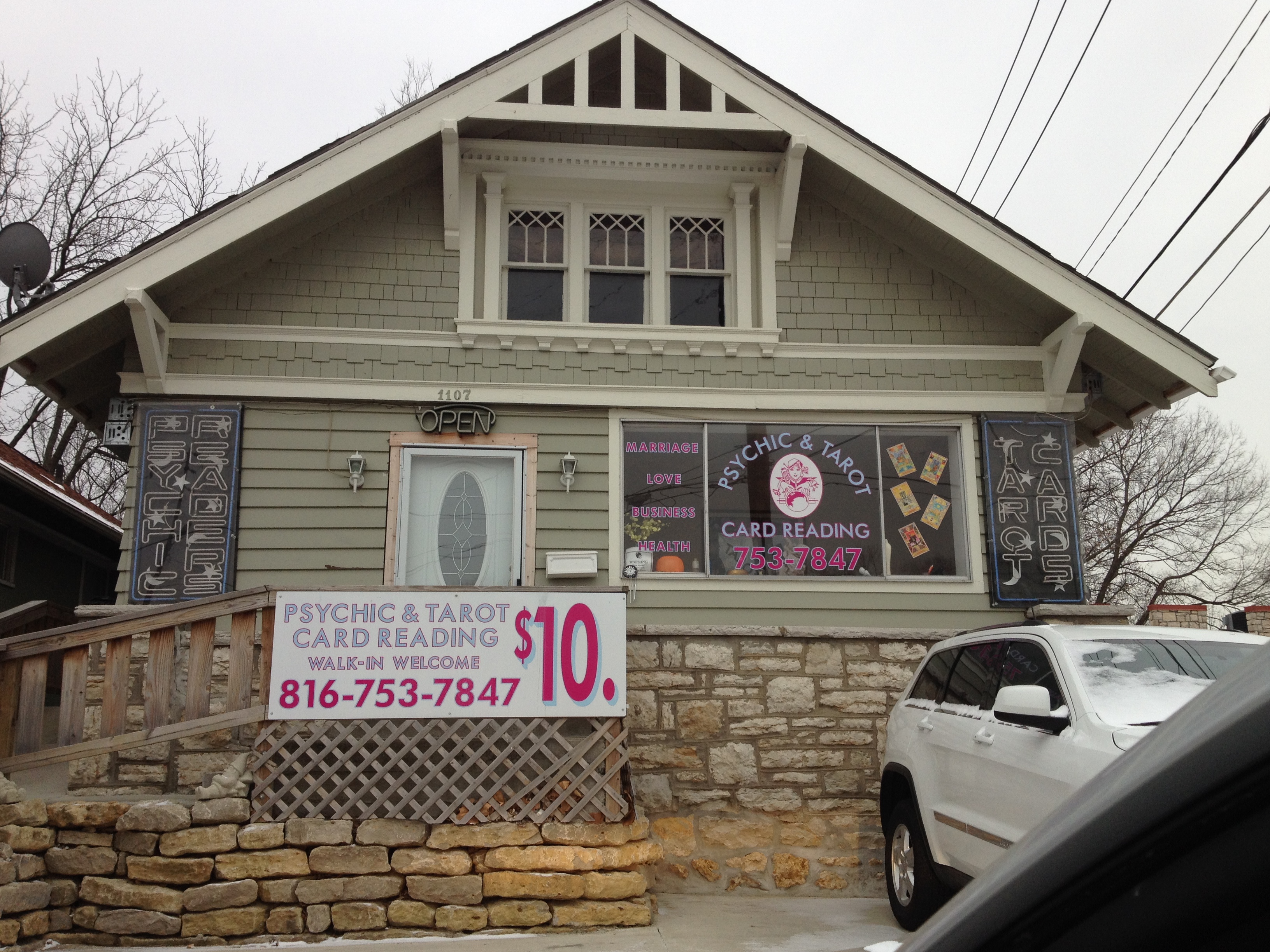
In Westport you can get your future told

There is more than one psychic in town where the future is told. From the way some of the young people dress around here, you may think there has been a zombie apocalypse.  It is hard not to stare at those faces whited out and eyes lined in dark liner on both the girls and the boys. You will see guys in baggy shorts even when it snows. I recognize the face of the homeless guys that sit at the Quick Trip asking everyone passing for their change, but I don’t know them personally. I say, “hi,” but I don’t give money to strangers.

A new neighbor renovates the house several doos down. A new neighbor renovates the house several doos down.

The construction doesn’t stop. On every block, a house is being renovated. The folks in the West Plaza area try to keep their properties looking good. A new neighbor, several houses down from me has been working on his place all year. Pounding of hammers and sawing, and murmurs of construction workers and then one day the imported Spanish windows arrived. I can’t wait to see what goes on next.

Art, blog, History, Kansas City, Story, Uncategorized

My House the Trading Post- Walk Around Town

Image
Art, blog, History, Kansas City, Story, Uncategorized

My House The Trading Post and the Crane

Wesport Catholic Church, image from catholichistory.org

Wesport Catholic Church, image from catholichistory.org

How do you feel about work? I often feel like this old fable, The Wolf and the Crane.

“A Wolf who had a bone stuck in his throat hired a crane, for a large sum, to put her head into his mouth and draw out the bone. When the Crane had extracted the bone and demanded the promised payment, the Wolf, grinning and grinding his teeth, exclaimed: “Why, you have surely already had a sufficient recompense, in having been permitted to draw out your head in safety from the mouth and jaws of a wolf.”

An English writer, named, John Ruskin, published his first novel in 1845. He gave a number of lectures and wrote some important books on art and architecture. He devoted himself to work on social problems. He suffered from bouts of madness and his writings expressed that. My private journal sometimes sound ‘like his writing rants. My psychiatrist told me to keep a journal, then she said she didn’t care what was in it, although she thought I was a good writer, the exercise wasn’t intended to be read.

I pout when I have a job, and I pout when I don’t have a job. Not having a job, gives me the freedom to write and read whenever I want.  Ruskin has said, “I have seen and known too much of the struggle for life among the laboring population to feel at ease, even under any circumstances, in inviting them to dwell on the trivialities of my own studies;”

He goes on to say, “No teacher can truly promote the cause of education until he knows the conditions of the life for which that education is to prepare his pupil.”

Westport Missouri, from the time it was formed until present day, has been a working class neighborhood. There is a book about the, “The Battle of Westport, Missouri’s Great Confederate Raid,” by Paul Kirkman.  Wars have taken place, the burning of Mormons, the Mexican War, Civil-War, Women’s Rights and other notable history. A lot has been written on such topics, but as I read the various historic events concerning Westport Missouri, I don’t see enough written about the common working citizen of Westport. (Granted most folks don’t want anyone knowing what they are doing.)  The past owners of this property were young people. This building holds the ghosts of the starter business owners.

I claim its greatest contribution to history is the fact that it just exists. It has to be noted that it is a wood structure. I think it is remarkable that the building has existed this long, because of the number of wars, battles, and fires that took place, and the capitalist nature of cities to knock it down and rebuild.

The history of Kansas City in my opinion, too often come from the stories of the Upper Classes. The history books all discuss the same characters, like; McCoy, McGhee, Yoacham, Boone, Ewing, Vogel, Harris, Wornall, Hickman, Thomas Hart Benten, Samuel C Roby, Henry Clay Pate. Here is a short list of who had a trading post or tavern in Wesport in the year 1845.  It is important to note that this is not a complete census. The town was already, very big by the time the pre-civil war saloon, I live in, was built.

The goal or lifestyle of the residents would have been work.  They were young working class men and women. The first settlers, would have been in their twenties.  As the town grew successful, and Kansas City, dug away the dirt and flattened the cliffs along the Missouri river, the wealthy families moved into new homes and buildings in downtown Kansas City. In downtown Kansas City, they established new public-houses, and built them in a wise manner, with a more expressive display of dignity for such establishments that would sale spirituous liquors.

This was the nature of the city, and has been ever since. Not to be political, but with each new Mayor, Kansas City tends to invest in a new construction project, often centered on building another shopping and entertainment area, as well as new construction for residential housing communities. Problem is, we haven’t run out of land, yet. So we don’t build up, we build out. Creating older, communities that struggle for business. New city projects always bring in the new technology, however, the consumers only seek the basic needs and comforts from Kansas City, because silly, we all can’t be rich. The worker in Kansas City simply picks up his or her lunch pail and heads north, south, east, or west for twenty minutes from where ever they live, and they go to work.

A Saloon’s Treasures In Pictures

A 1954 Jukebox, left behind by, plays only 50's tunes.

A 1954 Jukebox, plays only 50’s tunes.

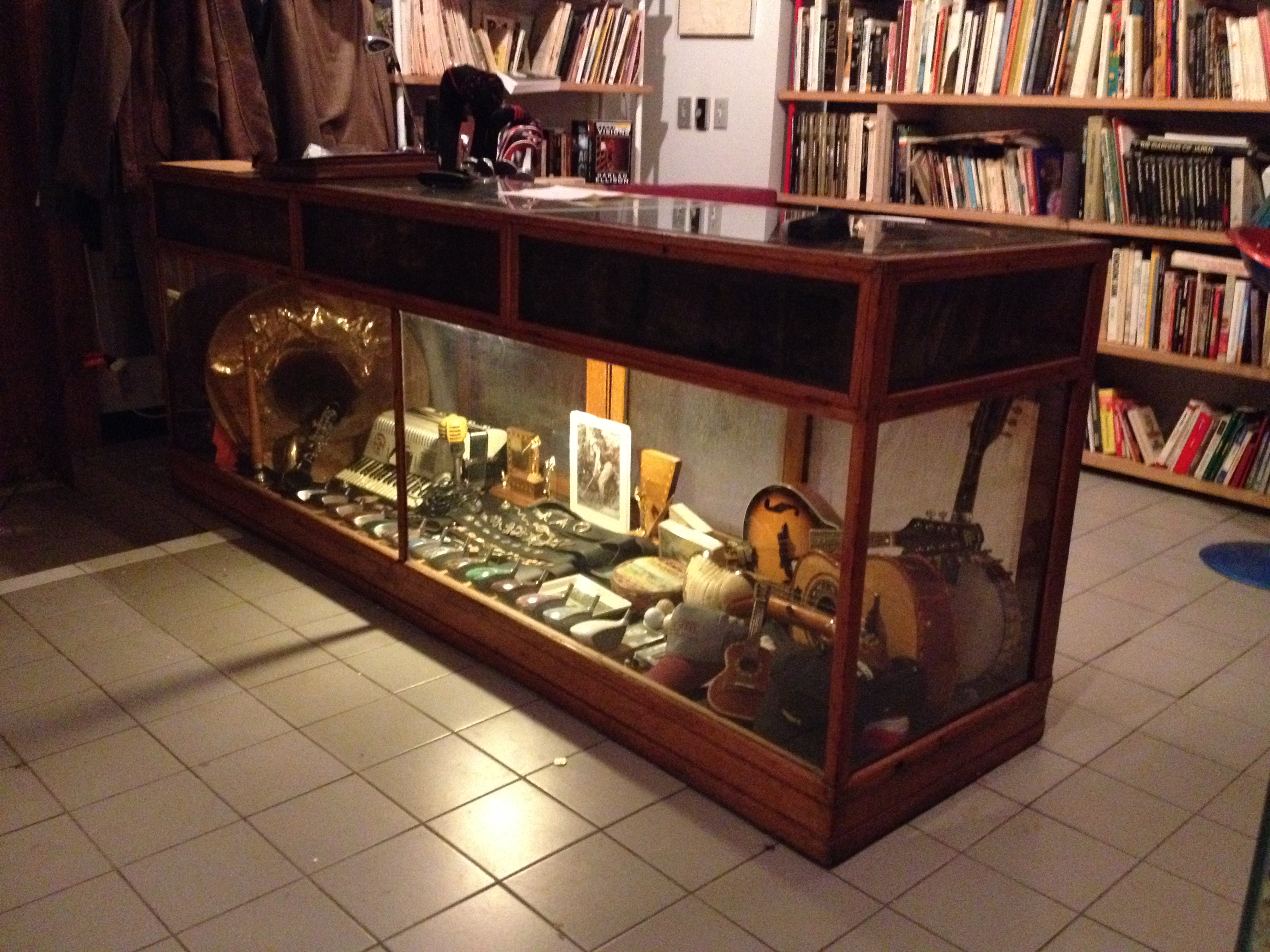
Antique display case, year ?

Antique display case, year ?

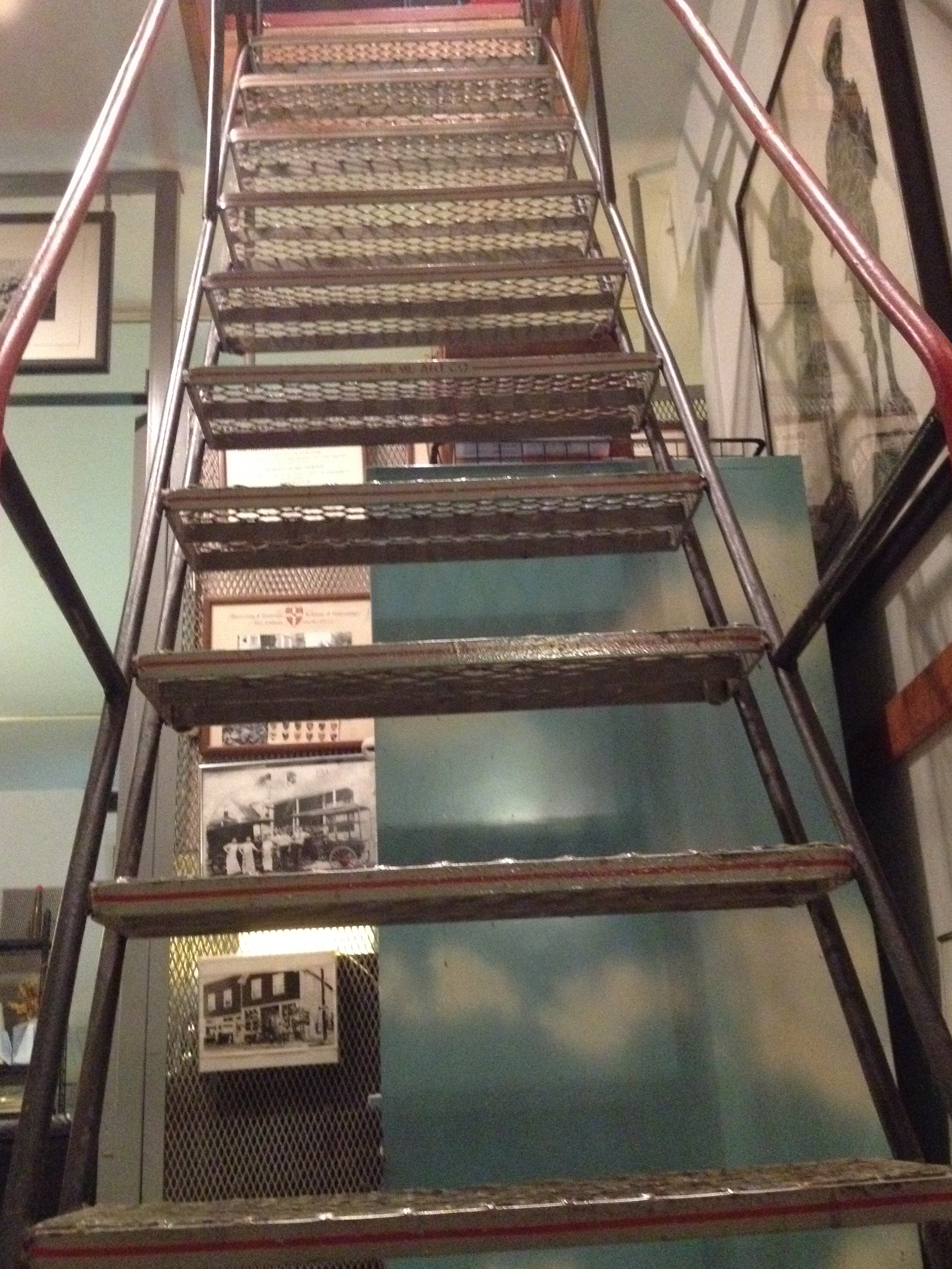
The only way up.

The only way up.

Standard